As compared to a few decades ago, women being part of the workforce has become the norm. However, while this has been viewed as a positive change, there is a noted lack of women in leadership. According to our DEIB report, ‘Despite women making up 26% of the workforce (a figure unchanged for three years), their representation sharply declines at each managerial level. The “broken rung” phenomenon persists, with only 8% of CEOs being women. Career interruptions post-maternity, lack of flexible work models, and unclear promotion pathways contribute to attrition and stagnation.”  

At Great Place to Work®, we help companies evaluate women’s representation in leadership, how existing employees feel about the current situation, and advise them on how to improve the workplace. This article will delve into the challenges, benefits, and strategies to help women in leadership thrive at work.   

What Does Women in Leadership Entail? 

Women have been part of the workforce since the 1900s and part of the corporate world for over the past five decades. However, the one factor that stands out is that even today, women are not a huge part of leadership. This statistic shows this clearly: ‘In 2025, 21% of women have not had the experience of leadership development opportunities.’  

Women in leadership are women holding higher positions on the corporate ladder, with immense decision-making power, influence over the company’s direction, and responsibility for leading significant aspects of the business.  

Women in leadership, in most companies, will include: 

  • Being part of the executive leadership team of the company 
  • Having a voice on the board of directors regarding the company’s strategy 
  • Leading teams and managing several aspects of their work and responsibilities 
  • C-suite executives who head a particular aspect of the company’s operations 
  • Heading the company as a managing director or chief executive officer 

Women in leadership make it easier for other women to join the ranks of leadership, enabling a diverse workforce to create a force that moves the organization in the right direction. 

Why Is It Critical for Women to Become Part of the Leadership? 

A study of a well-functioning and highly productive work environment will show that these outcomes result from balance, open communication, and a positive approach. Women and other under-represented groups in the workplace and in leadership are part of ensuring all the above-mentioned factors. Here are the benefits of women in leadership: 

  • Women bring an emotional intelligence angle to decision-making through balance 
  • Organizations gain a different and broader point of view 
  • The culture and outlook of the organization become more diverse 
  • It helps structure the benefits offered by the organization in a better way 
  • Businesses are better able to understand and serve customers 
  • Builds a better image of the business among all stakeholders 
  • Increased productivity and improved customer satisfaction positively impact the bottom line 

Challenges Women Face in Leadership Roles and Strategies to Overcome Them 

When women take on leadership roles, they face more challenges than their male counterparts. This can be due to societal, familial, and corporate pressures on them. Let’s look at some of the challenges. 

Challenge #1: Stereotyping and Gender Bias 

Often, women face a lot of gender bias from peers and leadership, which even they may not be aware of. There’s a lot of stereotyping around the kind of roles women can play and the skills they have. 

Some examples include: 

  • Assuming that women may not want to work on jobs that require manual skills or site visits where they have to be actively involved in physical tasks.  
  • Building a narrative where women use emotions for decision-making rather than logic and statistics. 
  • Viewing women as the weaker gender, not possessing the ‘killer instinct’ attributed to men who lead teams. 
  • Women lacking mechanical skills like repairing cars or working with software coding, making them incapable of leading in such roles 
  • Women leaders being uncomfortable leading a team of ambitious and aggressive men with a firm hand. 
  • Leadership assuming that women may not be ambitious because of the mother-wife roles they play along with their careers. 
  • Hormonal changes which are part of the woman’s life affecting their ability to work consistently and productively. 

Strategy # 1: Train Leadership to Overcome Bias 

Any change in the company’s outlook, culture, and overall attitude starts with the leadership team’s visible acceptance of these qualities. For the organization to overcome unconscious bias and the stereotyping of women, leadership teams must be trained. When leadership demonstrates a gender-neutral, merit-centric approach to work, this attitude permeates the rest of the organization.  

Here are some steps to make this strategy effective: 

  • Create and implement training programs that help people overcome their biases against women and other under-represented factions. 
  • Make it clear that any biases or gender-offensive attitudes will be dealt with strictly and will not be tolerated at any level. 
  • Provide mechanisms that enable women to record, report, and request support when they face such biases. 
  • Design recruitment processes to eliminate unconscious bias and standardize performance evaluations to avoid personal bias. 

Challenge # 2: Restricted Access to Leadership Roles 

Today, most companies welcome women into their ranks with open arms; however, not into leadership teams. It is often assumed that women will take career breaks to fulfill their personal commitments, which, in turn, makes them unsuitable for leadership roles. Another assumption is that women may not want to step into roles that require more responsibility. 

Some examples include: 

  • When companies consider potential leadership candidates, they focus mainly on service length, and women could show some gaps due to personal commitments 
  • Judging women by their leadership styles, as they may not always be the same as those of their male counterparts. 
  • Restricting women in leadership due to paucity of time they have for social and networking activities. 

Strategy# 2: Create Women-Specific Tracks and Leadership Programs 

It is a given that men and women think and act differently, which will also affect their leadership styles. However, to ensure that the company does not restrict women based on their working style, it is crucial to create women-specific tracks and programs.  

Here are some steps to make this strategy effective: 

  • Help women candidates identify their strengths and train them to improve in areas where they lack, ensuring they have a well-rounded skill set and can take on leadership roles. 
  • Aggressively promote mentorship programs to prepare women for their leadership roles by providing overall support on technical and emotional skills. 
  • Encourage existing women leaders within and outside the company to address women employees. 
  • Offer support in the form of training programs, certifications, courses, and sponsored workshops to prepare women for leadership roles. 

Challenge # 3: Interrupted Career Path Due to Personal Reasons 

Biology and nature have assigned women to caregiving and reproductive roles, which results in career gaps. Many women have successfully managed both these responsibilities, but this has also hindered their growth in the company.  

Some examples include: 

  • Women feel disoriented when they return from maternity leave due to changes in their roles and within the company. 
  • Some women have found themselves moved off the promotion track once they get married, on the assumption that their priorities have changed. 
  • Enable online meetings for important events, key client account handling, and crucial team events to keep the woman on leave updated on all changes and developments. 
  • Women with family responsibilities, such as caring for elderly parents or raising children, are often viewed as not suitable for leadership programs. 

Strategy #3: Enable Mentorship and Input During Such Situations 

Today, companies have become more understanding about supporting people, especially women as a whole, rather than only at a professional level. This strategy focuses on creating support systems and mentorship programs, and providing the right input to ensure that women on the leadership track move forward, no matter what. 

Here are some steps to make this strategy effective: 

  • Talk to women leaders to understand how they overcame these challenges to stay on track for leadership roles. 
  • Create programs that support women when their personal responsibilities create gaps in their schedules. For example, create a one-on-one support person for women who are on maternity leave. This person can keep the woman updated on developments in their work, clients, and any company changes. Furthermore, this person can also act as a liaison between the woman and the team to keep the link going. 
  • Partner with childcare services to ensure the woman leader can focus on work without worrying about missing any child-related issues. 
  • The Human Resources department can provide a forum for women with varied family commitments to seek guidance and support in difficult situations. 

Challenge # 4: Women Needing to Balance Work and Personal Life 

The world is evolving at a faster pace, and society’s outlook toward what women are responsible for has also changed. However, despite these changes, women still need to balance their personal and professional responsibilities. This could be due to societal pressures, specific skills that only women possess, and biological differences that confer traits men do not have. 

Some examples include: 

  • Women have more child-centric responsibilities, especially in their early years, due to the need to nourish their children during the first two years. 
  • Since women are often considered skilled at multitasking, they are expected to take on more household responsibilities than their male counterparts. 
  • Even when roles are divided equally, women often take on more of the personal load due to their nature. 

Strategy #4: Build a Flexible and Sustainable Hybrid Work Situation 

Companies seeking to encourage more women to take on leadership roles can adopt a strategy of offering flexible hybrid work arrangements that also measure productivity objectively. With hybrid working models, women can continue to perform at their best without sacrificing any aspect of their professional or personal responsibilities. 

Here are some steps to make this strategy effective: 

  • Identify all roles that can be performed without requiring employees to commute to the office and that support a viable hybrid work model. 
  • Empower these women with the right apps and tools to make communication with internal teams and external stakeholders easy and seamless. 
  • Enable them to create a professional, comfortable work setup at home to maintain a seamless experience when they interact with external parties. 
  • Set up mechanisms and establish metrics to measure performance without any bias and with complete transparency. 

Challenge # 5: Self-Doubts and Imposter Syndrome 

Historically, women have been placed in more subservient roles, and this has resulted in many women becoming victims of the ‘imposter syndrome’. When women doubt themselves, they often shy away from taking up leadership roles. 

Some examples include: 

  • Women in leadership roles often feel they have the skills but lack the confidence to lead a team with the necessary authority. 
  • Women are often unable to express their opinions or offer input in a male-dominated setting due to a lack of authority. 
  • Colleagues often put down women for being emotional, leading them to doubt the logic and merit of their input. 

Strategy #5: Offer Career Counseling and Support Services 

For women on the leadership track, it is often not a lack of skills or aptitude but doubt and a lack of confidence that lead them to shy away from such opportunities. Companies seeking to encourage more women to take on leadership roles must adopt a strategy that helps them discover their potential. 

Here are some steps to make this strategy effective: 

  • Build programs and support workshops to help women build their confidence and realize their complete potential. 
  • Highlight and share the achievements of women employees consistently, both within and outside the company. 
  • Offer courses on public speaking, mentoring, and discovering the power within to all those employees who show leadership potential. 
  • Identify leaders to mentor potential candidates in mentorship programs, helping them build confidence and learn new leadership skills. 

Challenge #6: Limited Networking Opportunities 

Traditionally, networking opportunities are restricted to clubs and night events where men meet and interact, resulting in an old-boys-club, which is a tight clique. Often, women either feel uncomfortable at such events or are unable to attend due to other commitments. In such cases, women miss out on crucial networking opportunities. 

Some examples include: 

  • Night events in clubs and places where entry is traditionally men-only in certain areas, restricting women from entering. 
  • Hunting, shooting, golfing, or other such events where men discuss business while participating, where many women may feel out of place or even unwelcome. 
  • Networking events that require investing time beyond work hours, which may not work for many women due to their personal responsibilities. 

Strategy #6: Build Professional Networking Events That Are Women-Friendly and Accessible 

While it is true that many business deals occur in social settings, it is important to have a strategy to ensure women do not miss out on opportunities to network, increase visibility, and close deals. The strategy is simple: schedule business events around times that work for the entire leadership team, including women.  

Here are some steps to make this strategy effective: 

  • Schedule events and meetings at times and places where women can also participate. For example, move the meeting to a hotel luncheon rather than a game night at a club. 
  • Form specific groups and forums where women can represent their skills. This can be at a board meeting or a client-based event where the celebrations occur only when business negotiations are concluded. 
  • Enable women to attend evening or night events by offering them the required support in terms of transportation, childcare, and accommodation as required. 

How to Ensure the Growth of Women in Leadership Roles Going Forward? 

The world is recognizing the need to recruit women actively, encourage their growth, and support their advancement into leadership roles. Having a well-balanced team with representation from all segments creates a positive and productive work environment. The starting point is to check the organization’s pulse through employee surveys

Another great way to kickstart this is to talk to an expert about DEIB to assess the current position and move forward. Change must start at the leadership level and permeate to lower levels to ensure the proper implementation of any women-in-leadership initiatives. At Great Place To Work, our team of experts can guide the process and ensure tangible results. Click here to connect with us

Frequently Asked Questions 

Why is it crucial to develop women in leadership roles? 

Women bring a different perspective and skills to any role they take on. With women in leadership roles, the company will benefit from increased productivity and creative solutions. Having women in leadership also builds a better image of the company internally and externally. 

What are the steps to take to encourage women to take leadership roles? 

Companies can start by identifying women leaders among existing employees and offer them training and support to encourage them to take on leadership roles. Moreover, women-specific initiatives can support women across various phases of their personal and professional lives, helping them continue their career trajectories. 

What programs can support women in leadership? 

Programs such as young executive boards, mentorship, networking events, and targeted soft-skills training can help women discover and develop their innate leadership skills. Support facilities such as hybrid working, maternity leave support, and opportunities to interact with other women leaders can also help. 

What issues do women in leadership face? 

Women in leadership can face issues at both personal and professional levels. At the personal level, a need to focus on their family, having babies, travel limitations, etc., can be some of the issues. At the professional level, challenges can include male colleagues not accepting them, a lack of confidence and networking opportunities, and a poor understanding of their specific needs.

Some organizations bend under pressure. Others build through it. The gap between the two rarely comes down to strategy or resources. It almost always comes down to leadership. Not leadership as a title or a position in an organizational chart. Leadership is a practiced set of skills that show up daily in how managers communicate, how they make decisions, how they respond to failure, and how they create the conditions for others to give their best. 

Great Place To Work® India’s research, conducted across 540 IT companies and 3.4 lakh employee voices, puts hard numbers to what many organizations sense but struggle to prove: the leadership skills managers carry determine business outcomes, not just culture scores.

What Are Leadership Skills? 

Leadership skills are the specific behaviors, capacities, and decision-making patterns that allow an individual to guide, influence, and build others toward shared outcomes. They are distinct from technical expertise or functional knowledge. A brilliant engineer or a sharp analyst does not automatically become an effective leader. Leadership skills are learned, practiced, and refined over time.

Also Read: 5 Leadership Levels That Shape Workplace Culture

In the workplace, leadership skills show up in concrete moments: how a manager responds when an employee shares a concern, whether a senior leader makes decisions that others can understand and trust, whether a team feels psychologically safe enough to flag a problem before it becomes a crisis. 

Great Place To Work’s research identifies 9 core leadership behaviors that matter most to employees across India’s workforce: 

  • Hiring & Welcoming: Attracting the right people and ensuring they feel genuinely included and valued from the very first day. 
  • Caring: Being genuinely present for the team, not just operationally available but personally invested in their wellbeing and growth. 
  • Celebrating: Recognizing contributions consistently and making people feel seen and appreciated for their effort and hard work. 
  • Inspiring: Helping colleagues understand how their role connects to larger business goals and a purpose that goes beyond day-to-day tasks. 
  • Speaking: Communicating with clarity and honesty while creating an environment where open dialogue is welcomed, and differing views are never penalized. 
  • Sharing: Using data insights to make fair and transparent decisions so that information flows equitably and people trust the process. 
  • Listening: Genuinely hearing alternative perspectives before acting, making people feel truly understood rather than simply heard. 
  • Developing: Investing in the long-term capability of individuals, building their confidence and readiness to think and execute at scale. 
  • Thanking: Expressing sincere and timely gratitude in ways that reinforce trust, belonging, and a culture where people know their efforts matter. 

Taken together, these are not only soft skills. They are business-critical competencies with a measurable impact on performance, retention, and growth. 

How Do Leadership Skills Directly Impact Business Performance? 

People are the drivers through which every business strategy gets executed. Strategy lives in documents, but execution lives in people. And how people execute depends almost entirely on the leadership environment they work within. 

When Great Place To Work analyzed data across Certified™ and non-certified companies, the gap was quite visible. Employees working at Certified workplaces rate their leadership experience significantly higher, scoring 25% higher than in typical workplaces. That gap does not stay confined to culture surveys. It translates directly into whether employees choose to stay, innovate, adapt, and go the extra mile. 

Employees who experience positive leadership are 61% more likely to intend to stay; compared to just 39% among those who do not. That difference is the business case for leadership development.

The research also reveals a compounding effect. When employees have strong confidence in their leadership’s judgment, 87% show significantly positive responses to AI-related experiences, meaning they are excited about new tools, open to learning, and hopeful about change. Leadership trust does not just retain people; it determines how readily an organization can absorb transformation. 

The impact of leadership is also not uniform across levels. Individual contributors score their leadership experience at 55%. C-level executives score it at 78%. That 23 percent gap is one of the most underappreciated risk factors in Indian organizations today.  

Top Leadership Skills That Drive Business Success 

Across industries and generations, employees share a remarkably consistent picture of what they need from their leaders. The skills below are not aspirational checklists; they are the behaviors that show up in the data as the true drivers of trust, performance, and retention. Understanding them is the first step to building leadership that actually works. 

1. Purpose Alignment 

People do not just want to do their jobs. They want to know why their job matters. The most effective managers are the ones who take time, whether in a quick team to huddle or a one-on-one conversation, to connect everyday work to a bigger picture. When employees understand how their contribution fits into something meaningful, they bring more energy, stay more focused, and push through challenges more willingly. Moreover, employees most frequently identify aligning their work with a clear purpose as the experience that best reflects their current manager.  

2. Empathy and Emotional Intelligence 

Great managers pay attention to people, not just performance. They notice when someone is struggling. They ask the right questions. They create space for honest conversations. This is what empathy looks like in a workplace setting, and it is quite questionable practice as well.  

When employees feel genuinely understood by their manager, they are more likely to speak up early, take initiative, and stay committed even when things get hard. Empathy and emotional intelligence ranked highest at 44% among the qualities that will define great leadership in 2030. 

3. Consistent Recognition and Trust-Building 

A simple thank you at the right moment can do more than a formal reward program. What employees want is to feel seen for their effort, consistently and fairly.  

The problem in many workplaces is not only the absence of recognition but also the inconsistency of it. When some individuals are celebrated while others doing equally good work are overlooked, it quietly damages the trust within a team. Managers who make recognition a regular habit, not an occasional gesture, build teams that genuinely want to give their best. 

4. Strategic Decision-Making 

Employees are not just frustrated by bad decisions. They are frustrated by decisions that feel unclear, unexplained, or disconnected from reality.  

What builds confidence in a leader is not perfection but transparency. When managers communicate clearly about what they decide, why they decide it, and what it means for the team, people feel informed and respected. That clarity is what allows teams to move quickly and execute well without second-guessing every step. 

5. Adaptability 

Things change, plans fall apart, and unexpected challenges come up. What employees remember is how their leader responded. Did they step in or step back? Did they adjust or hold rigidly to a plan that was no longer working?  

Adaptable leaders do not have all the answers but they stay calm, stay present, and help their teams navigate uncertainty without panic. That steadiness is what gives people the confidence to keep going when things get difficult. 

6. Tech Readiness and AI Literacy 

Employees are not just looking for leaders who understand technology. They are looking for leaders who help them feel confident about it. Change brings anxiety, and when a manager is visibly comfortable with new tools and willing to guide the team through them, that anxiety reduces significantly. Leaders who engage openly with technology, including AI, signal to their teams that learning and adapting is safe. That is more empowering than any training program. 

7. Psychological Safety 

When employees do not feel safe to speak up, the best ideas within an organization remain unheard. Psychological safety creates the conditions for honest, productive dialogue at every level. It enables individuals to raise concerns before they escalate, respectfully challenge decisions without fear of repercussion, and acknowledge gaps in knowledge without hesitation.  

Leaders who build this environment do not simply improve team morale. They build organizations that are sharper, more responsive, and better equipped to handle complexity. 

8. Active Listening and Openness 

There is a meaningful difference between a manager who hears what an employee says and one who actually listens to. Active listening means engaging with what is being shared, asking follow-up questions, and being genuinely open to changing course based on what you learn. When employees feel truly heard, they trust their leader more, communicate more honestly, and raise concerns earlier. When they feel ignored, they stop sharing, and organizations lose access to some of their most important signals. 

9. Integrity and Reliability 

At the end of the day, employees want to know they can count on their manager. They want consistency, fairness, and follow-through. They want a leader who says what they mean and means what they say. Integrity is not about being liked. It is about being trustworthy. And in high-pressure environments where change is constant, a reliable and fair manager becomes the anchor that holds a team together. 

How Do These Skills Improve Business Performance?

When employees experience all nine behaviors in combination, the business outcomes are not marginal. They are multiplicative:

Business Outcome Multiplier Effect
More likely to adapt quickly to organizational change 2.3x
More likely to look forward to coming to work 2.3x
More likely to intend to stay long-term 2.1x
More likely to receive innovation opportunities 1.9x
More likely to put in extra effort 1.7x


These outcomes are consistent across IT, BFSI, Retail, Manufacturing, and Pharma, suggesting the relationship between leadership quality and business performance is not industry specific. When employees trust their manager, they communicate openly and problems get caught early. When people feel valued, they keep giving their best without burning out. When leaders create psychological safety, teams take the small risks that lead to real innovation. All of these are the compounds of the above-mentioned business outcome. 

Conclusion 

Leadership skills are not a soft business investment. They are direct drivers of retention, adaptability, innovation, and extra effort. Great Place To Work India’s Voice of India 2025 study and the 9 Leadership Behaviors analysis across six sectors and thousands of companies make this connection explicit and quantifiable. 

The organizations that will outperform in 2026 and beyond are the ones that treat leadership development as seriously as product development or financial planning, with rigor, measurement, iteration, and investment.  

Frequently Asked Questions 

What is the link between strategic thinking and profitability? 

Strategic thinking drives focus on high-value opportunities and faster adaptation, which is a key to executing strategy and improving profitability. 

Can leadership skills improve employee engagement and retention? 

Yes, employees with positive leadership are significantly more likely to stay and remain engaged. 

How does emotional intelligence affect organizational success? 

It builds psychological safety, enabling open feedback, faster problem-solving, and stronger innovation. 

How long does it take to develop strong leadership skills? 

With consistent feedback and coaching, noticeable improvements typically occur within 6 to 12 months.

Every organization wants strong leaders. But the first step starts with getting intentional about building leaders who are future-ready. There are employees who are exceptional in their skills and talent but fail when it comes to leadership roles. Leadership gaps don’t usually come from a lack of talent, they come from a lack of structured development. High performers get promoted, critical talent gets stretched, and suddenly, individuals are expected to lead without ever being prepared for it. The result is inconsistent team experiences, declining trust, and missed business outcomes. 

At Great Place To Work®, one insight consistently stands out. Great workplaces are built by leaders who create high-trust, high-performance environments – not by policies alone. This is why Leadership Development Programs must evolve with changing requirements and trends. They cannot be limited to training sessions or one-time interventions. They must become intentional systems that build leadership capability through experience, exposure, and behaviour. 

What Are Leadership Development Programs? 

The goal of leadership development is to improve an individual’s ability to lead, motivate, and influence people within their team and inside a company. The objective is to develop critical leadership skills including communication, decision-making, emotional intelligence, and strategic thinking. These abilities enable both present and future leaders to effectively manage difficult situations and adjust to changes. 

Leadership development concentrates on the more ethereal traits that characterize exceptional leaders, whereas general management training concentrates on the practical and administrative abilities required to oversee daily operations. It places a strong emphasis on self-awareness, personal development, and the capacity to inspire and empower others.  

Basically, leadership Development Programs are structured approaches organizations use to build leadership capability across levels. But the most effective ones go beyond skill-building. 

They focus on developing: 

  • Decision-making under ambiguity  
  • Ability to influence without authority  
  • Trust-building within teams  
  • Inclusive and fair leadership behaviours  
  • Adaptability in fast-changing environments  

In simple terms, they prepare individuals not just to manage work, but to lead people and culture. 

Why Organizations Need Leadership Development Programs?

Great-place-to-work-india

Organizations that do not invest in leadership development often experience uneven manager effectiveness, lower employee trust, higher attrition among top talent, and reduced innovation and agility. Leadership is the multiplier of culture. Effective leaders steer their groups toward shared objectives, boosting output and effectiveness. They make strategic choices that have the power to influence an organization’s destiny and provide an atmosphere in which employees may flourish. In the end, this enhances an organization’s long-term viability, financial performance, and competitive edge. 

When leaders are strong, teams thrive. When leadership is inconsistent, even the best strategies fail. Therefore, investing in leadership learning and development also guarantees that employees have a greater stake in the success of their company. Even strong Leadership Development Programs help organizations in building a future-ready leadership pipeline, improve employee experience, strengthen culture consistency across teams, and drive sustained business performance. Additionally, leadership development coaching offers focused, individualized advice that helps leaders overcome certain obstacles and accelerate their progress.  

Leadership Development Starts Earlier Than You Think 

One of the biggest mistakes organizations make is starting leadership development too late. Leadership does not begin with a title. It begins when individuals start to: 

  • Take ownership beyond their role  
  • Influence decisions  
  • Collaborate across teams  
  • Step up during uncertainty  

Organizations that build strong leadership pipelines identify these signals early and invest in them. Because by the time someone becomes a manager, their behaviours are already shaped. The goal is to build leadership early. 

Who Should Be Included in Leadership Development Programs? 

Leadership development should be focused, not generic. Here are two group of people who are critical to be included in the leadership development programs: 

1. Next in-Line Leaders 

These are individuals expected to move into leadership roles in the near future based on their existing position in the company. They may already be leading projects, guiding peers, and taking ownership beyond their role. Investing in this group ensures smoother transitions and reduces the risk of ineffective first-time managers. This also ensures that if any of the existing leaders cannot perform their duties, then you’ll always have someone ready to take ownership. At this point, you’ll not have to figure out how to get started because you already have a ready pipeline.  

2. Critical Talent 

This includes high performers and individuals who are difficult to replace. 

You can identify such people if they typically: 

  • Go beyond their role and expectations 
  • Deliver strong business outcomes  
  • Hold key institutional knowledge 
  • Influence team performance  
  • Take ownership of a team project 

It is even more important to develop this group because if not done effectively, they might become disengaged or exit. But if developed well, they become the next generation of leaders.

Top 5 Leadership Development Programs That Actually Work

Leadership development programs

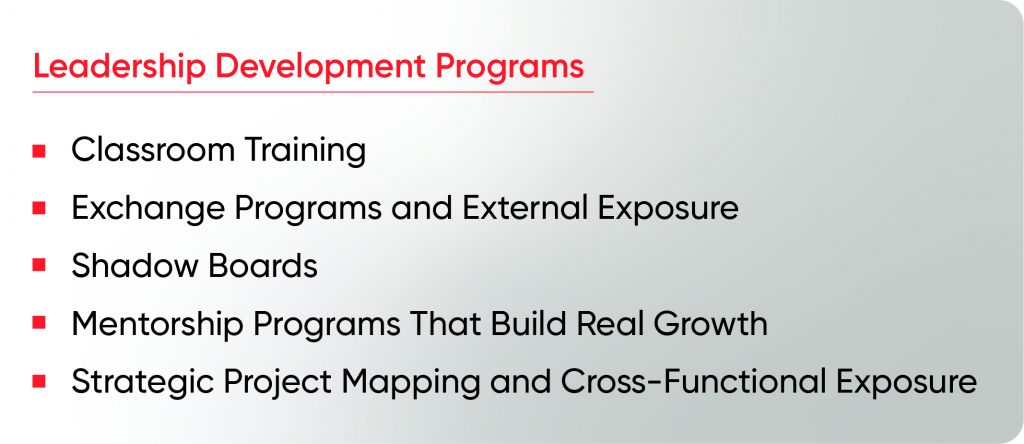
The most effective Leadership Development Programs are not standalone initiatives. They are built through a combination of learning, exposure, and real-world responsibility. 

1. Classroom Training  

Classroom training still has a role, but only when it goes beyond theory. This is the most traditional kind of training program that not only provides knowledge but also changes behaviour. These are structured meetings focused on roles, responsibilities, strategic thinking, and emotional intelligence of an individual. Now, these sessions can be conducted in different forms and capacities.  

a. Tie-ups with External Programs (Sending People Out) 

Organizations can partner with institutions or curated learning experiences to expose employees to: 

  • New perspectives  
  • Structured leadership frameworks  
  • Cross-industry insights  

Employees are made aware of the industry’s best practices, structures framework, and a lot of other things that they can take back to their organization and implement in phases. Here, the real value does not lie in attending the sessions but in the post-learning application.  

b. Bringing in External Experts  

The other form of classroom can be inviting external experts into the organization, which allows learning to be: 

  • Contextual to business challenges  
  • Scalable across teams  
  • Interactive and discussion-led  

The major benefit of this form of training is that your employees will be able to gain outside perspective and knowledge. This will prepare them to deal with industry-related concerns.  

c. Focus on Behavioural Capabilities 

Modern leadership is behavioural, not just technical. Leadership today is about managing complexity, not just executing plans. The programs do not only focus on the skills required by an individual based on his or her job roles, but also on other basic skills that are required for leadership, such as: 

  • Agility – navigating constant change  
  • Resilience – sustaining performance under pressure  
  • AI-readiness – understanding how technology impacts decisions and teams  

2. Exchange Programs and External Exposure 

Leadership expands with exposure. Building a healthy pipeline requires exposure beyond your internal practices. Learning from experiencing how other people and organizations operate can lead to a different perception for your people, and this is how a company grows.  

a. Attending External Events 

Encouraging employees to attend industry events helps them understand emerging trends, learn from peers, and build external networks.  This exposure often translates into fresh ideas internally. 

Also Read: How Levels of Leadership Shape Workplace Culture

Great Place To Work is committed to bringing these experiences to you in the form of our biggest event, For All Summit, which takes place every year in February. Not only this, but we also conduct The Great Connects in different cities like Pune, Bangalore, Chennai, Delhi, and Ahmedabad to make networking more accessible for you.  

b. Sending Employees as Speakers 

This is a powerful leadership accelerator. When employees represent the organization externally, they build confidence, refine their thinking, and develop executive presence. It also signals trust, which in itself builds leadership behaviour. 

3. Shadow Boards  

A shadow board is a group of high-potential employees who work alongside senior leadership. This is one of the most impactful leadership development programs. The loop starts with identifying critical talent and bringing them into important conversations. 

By involving employees in key meetings, organizations enable them to understand strategic decision-making, see real business challenges, and contribute fresh perspectives. This is leadership development in its most authentic form, which is not simulated, not theoretical, but real. 

4. Mentorship Programs That Build Real Growth 

Mentorship programs are often practiced and seen as real growth builders. Companies often implement such programs but rarely optimize them to achieve the best outcome. 

a. Relatable Mentors and Coaches 

Before scheduling any mentorship program, the organization must decide on the group of people who will attend this program and what the intended outcome is. For example, if most of the people who’ll be attending this program are from the sales and marketing department, then the mentor should be a chief marketing officer or someone who has already served in a higher position in marketing. This is crucial because effective mentorship depends on alignment. Similarly, if the group attending the session is leaders from across the organization, then the mentor can be someone who can help them with critical thinking and decision making. The brownie point will be if he has worked in diverse industries at different positions, so that he is capable of guiding the people of different departments.

Also Read: What Great Managers Do Differently?

Moreover, a mentor should be approachable, experienced in relevant challenges, and capable of providing honest and actionable feedback. This could include internal leaders or external coaches. 

b. Combining Mentorship with Coaching 

Mentorship provides direction, and coaching builds self-awareness. Together, they help individuals reflect on behaviors, improve decision-making, and grow consistently over time. Leadership can’t be taught; it can be developed through reflection and feedback.   

5. Strategic Project Mapping and Cross-Functional Exposure 

Nothing builds leadership like responsibility. High-potential employees can be mapped to strategic initiatives, cross-functional projects, and business-critical challenges. This helps them understand the organization holistically, collaborate across teams, and make decisions with broader impact. This is where leadership capability becomes visible. Because leadership is not learned in isolation, it is learned through everyday action. 

What Makes Leadership Development Programs Truly Effective? 

Many organizations implement some of these initiatives. But effectiveness depends on how they are connected. Strong leadership development programs are: 

Continuous 

Leadership is built over time, not in isolated sessions. Therefore, one session will not do the needful; you’ll have to plan a series of sessions, which can be a mix of the above-mentioned programs as per your requirement.  

Experience-Led 

Real-world exposure matters more than theoretical knowledge. Therefore, you should consider external exposure and exchange programs as part of your L&D strategy for leaders.  

Behaviour-Focused 

Leadership is about how individuals show up, not just what they know. These training programs will not focus on an individual’s specific skill sets but on overall behaviour.     

Aligned with Culture 

Leadership development must reflect the organization’s values and expectations. Such programs should be designed to align with the organization’s culture because leaders are also culture makers.  

Reinforcing Leadership Through Recognition 

Leadership development does not end with programs. It is reinforced through everyday behaviours. Leaders repeat what organizations recognize. When behaviours such as: 

  • Inclusion  
  • Collaboration  
  • Ownership  
  • Innovation  

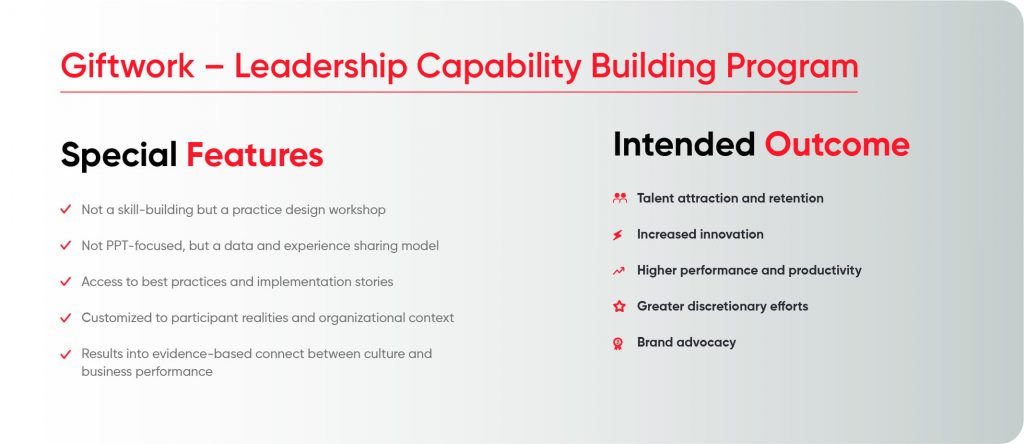
are consistently recognized, they become embedded in culture. This is where leadership capability-building programs like Giftwork® play a critical role. By enabling real-time, value-based recognition, organizations can reinforce leadership behaviours at scale, build a culture of appreciation, and make leadership visible across levels. Because leadership is not just developed in structured programs. It is strengthened in everyday moments.

leadership-building-capability-program

Conclusion 

Leadership development programs that actually work are not about sending employees to training. They are about building an ecosystem where leadership can grow. Organizations that succeed are the ones that identify potential early, provide meaningful exposure, create opportunities to lead, and reinforce the right behaviours consistently. Because leadership is not created overnight, it is built through experience, trust, and culture. 

Therefore, organizations that invest in building leaders don’t just strengthen their pipelines. They build great workplaces where people and performance thrive together. 

Frequently Asked Questions 

1. What are Leadership Development Programs? 

They are structured initiatives designed to build leadership capability, behaviour, and mindset within an organization. 

2. Who should be part of Leadership Development Programs? 

Next-in-line managers and high-potential critical talent should be prioritized for leadership development programs. 

3. What makes leadership development effective? 

In order to ensure the effectiveness of leadership development, there should be a combination of learning, real-world exposure, mentorship, and continuous feedback. 

4. How can organizations build future leaders internally? 

Future-ready leaders can be built by providing structured opportunities, strategic exposure, and reinforcing leadership behaviours through culture.

Key Takeaways:

1. Inclusive leadership is a business strategy that helps generate revenue from new products and enables better business decisions.

2. The foremost effect of inclusive leadership is fostering an environment of safety in which people perform at their fullest potential.

3. Inclusion comes from consistently enabling people to be their true selves through active listening, encouraging inclusivity in daily work, and practicing through actions. 

In today’s competitive world, businesses are looking for ways to gain a competitive advantage over others. One way to do that is with inclusive leadership. Until a few years back, inclusivity in the workplace was a good-to-have factor that most companies showed insincerity to.  

However, in today’s world, DEIB (Diversity, Equity, Inclusion, and Belonging) forms the foundation of growth and profitability for businesses. As per the report on the State of DEIB in 2025, ‘Organizations are moving beyond symbolic actions toward structural change, prioritizing fairness in access and opportunity. Data from our Great Place To Work® Voice of CHRO survey suggests that 64% of CHROs report a strong sense of belonging across their organizations, signaling a shift toward cultures of equity, inclusion, and shared growth.’  

The Great Place to Work® team works with its customers to understand where an organization stands on DEIB initiatives and helps them implement the right measures.

What Does Inclusive Leadership Mean? 

Inclusive leadership is a proactive approach that ensures diversity is part of the organization’s DNA. With a top-down approach, an inclusive leader helps all team members, regardless of gender, orientation, age, disability, or other factors, feel respected, valued, and included. They ensure that all voices are heard, an atmosphere of encouraging inputs is maintained, and that diverse perspectives are welcomed.  

To be effective and inculcate a culture of inclusivity at every level, an inclusive leader will display the following traits: 

  • Committed to inclusivity: As a leader, the inclusive leader will actively and consciously demonstrate their commitment to making inclusivity a priority. 
  • Courage to question: Inclusive leadership will need leaders who dare to question what is happening, examine the status quo, and hold themselves responsible, where required. 
  • Recognize bias: An inclusive leader will evaluate their personal biases, study organizational biases, and work to create processes to mitigate them. 
  • Be voraciously curious: Inclusive leadership is based on curiosity, open-minded listening, and seeking input from all levels of the organization. 
  • Culturally aware: Building on their curiosity to learn about others, an inclusive leader will learn about other cultures and show sensitivity in situations involving cross-cultural interactions. 
  • Collaborate continuously: As an inclusive leader, it is crucial to collaborate with others and encourage teams across the organization to do the same. 

Inclusive leadership brings a host of benefits that influence both short and long-term aspects of a business.  

Improved employee commitment 

Employees are more committed to the organization when they feel accepted, included, and valued. Inclusive leaders ensure they listen to employees’ input without bias, accept suggestions, and appreciate their work. This results in improved productivity, reduced absenteeism, and better retention rates. 

Inclusive and better decision-making 

When an inclusive leader leads a team, team members are likely to feel comfortable enough to share their unique perspectives. This, in turn, results in informed decisions, out-of-the-box solutions, and better business outcomes.  

Innovative approach to problem-solving 

People from different backgrounds, ages, and experiences approach the same issue from different angles, which can lead to unique solutions to business problems. Inclusive leadership encourages people to be innovative and to develop diverse solutions that benefit the organization. 

Positive impact on the company’s image 

A company that is truly committed to inclusive leadership is more likely to launch new products, move into new territories, and offer unique solutions to existing problems. By doing so, the company will gain a reputation for offering excellent products or services and for being an excellent employer, attracting customers and top talent.  

Enhanced financial performance 

Businesses with inclusive cultures often have a stronger presence in the market and can keep up with changing market needs. As a result, they often see an uptick in revenue, a consistent increase in market share, and improved customer satisfaction.  

How Does Inclusive Leadership Encourage Innovation? 

The foundation of innovation in any field is the ability to develop diverse approaches, and inclusive leadership lays the groundwork to enable this. Inclusive leadership encourages people at all levels and from all backgrounds to think differently and contribute their input.  

When this happens, innovation results as employees have the freedom to challenge the status quo, seek new opportunities, and offer creative solutions.  

With inclusive leadership at all levels, the company can ensure that: 

  • Ideas are not limited to a particular department or hierarchy 
  • Employees feel secure enough to share their ideas and take risks 
  • People have the wherewithal to collaborate across the organization 

Inclusive leadership weaves innovation and participation into the organization’s culture rather than treating them as forced initiatives. Different levels of leadership shape workplace culture in different ways. 

What Are the Best Practices to Build Inclusive Leadership? 

The culture of an organization permeates from the leadership level to the rest of the organization, and the best practices for building a culture of inclusive leadership start at the top. 

Emotional intelligence workshops 

Set up and offer emotional intelligence workshops to people at various levels. Work on aspects like active listening, recognizing unconscious bias, and inclusive communication. Running workshops like this regularly, or gamifying these concepts, will help people work toward becoming more inclusive. 

Create safe channels 

Employees are often not forthcoming about their ideas and feedback because they fear rejection, repercussions, or mockery. Ensure that your company has safe spaces, people, and channels where people can offer their input. Allow people to acknowledge and learn from their mistakes as required. 

Inclusive decision-making 

Inviting diverse perspectives, encouraging participation, and removing barriers, such as hierarchy in decision-making are great ways to ensure inclusive leadership. 

Feedback loops 

Check the pulse of employees through regular surveys and town hall sessions to encourage people to share their feedback. Collate the feedback, pinpoint the aspects to be implemented, and share it with the larger team. 

Rewards and recognition 

Establish a rewards program to recognize people who have offered unique perspectives that have resulted in success. Recognize contributions both at the individual and team levels.

Impact Measure Importance
Brand perception Employee and customer surveys Helps in talent retention and improving Lifetime Customer Value (LCV)
Innovation and product launches Product feedback and customer complaints Offers insights into where the company is lagging and areas for improvement.
People outcomes A mix of people from different backgrounds, and how well they feel supported Talent acquisition and ensuring that performance is on the uptick

How to Leverage the Benefits of Inclusive Leadership?

In conclusion, businesses need to realize that inclusive leadership is not an option but a critical aspect of their growth strategy. It is about ensuring that people from all walks of life feel valued, secure, and motivated to perform at their best. At Great Place To Work, the team helps companies transform their culture with culture consulting services.  

Want to know how to take this forward? Click here to connect with us 

Frequently Asked Questions

Why is inclusive leadership crucial for the growth of a business?

Inclusive leadership makes it easier for a company to attract and retain the top talent in the industry, meet customer expectations, offer innovative products, and maintain a good public image.

What is the first step to becoming an inclusive organization?

The first step to becoming inclusive is recognizing and acknowledging that talent is not limited to a particular age, gender, or type of person. Making it part of your company policy to accommodate people from all walks of life based on their talents or skills, and to offer them a good working environment, also helps.

How does inclusive leadership help us become profitable? 

    With inclusive leadership, the company becomes more innovative, solves problems, and ensures continuity. This, in turn, lowers costs, expands the customer base, and builds a positive market reputation, making the company profitable.

    Whose responsibility is ensuring inclusive leadership? 

      While the process of ensuring inclusive leadership starts at the top, it is the responsibility of everyone in the organization to ensure an inclusive environment.  

      Is inclusive leadership a one-time exercise or a continuous process? 

        Inclusive leadership is a continuous process in which every member of the organization commits to working hard to overcome biases and become more inclusive.