Imagine coming to work every day, not out of obligation, but because the workplace genuinely feels welcoming and nurturing. Such feelings do not come from a fancy office or a competitive salary alone. It’s what happens when a company treats its employees like its biggest strength. 

The reality in most Indian workplaces today is quite opposite. Wellness “programs” are a fruit bowl nobody touches, a health talk nobody attends, a PDF policy nobody reads. The intention is fine, but they fall far short of what employees are actually looking for. 

The good news is that organizations that take employee wellness seriously see real results: Better retention, stronger engagement, higher productivity, and a workplace culture where people genuinely thrive. Research from Great Place To Work® India found that leaders who genuinely listen to their teams drive 3.7x higher intent to stay. That’s not a soft metric; that’s retention.   

Why Health and Wellness Activities at Work Matter More Than Ever? 

People’s experience with work has shifted significantly. Heavy workloads, no real off switch, and an always-on culture that treats exhaustion as dedication. The stress isn’t obvious; it just builds up until someone burns out or moves away.  

Organizations that recognize this transition early on are those that create environments in which employees want to stay. When employees feel encouraged not only professionally but also as individuals, the difference is visible everywhere. This can be seen in how they approach work, how they treat their coworkers, and how long they choose to stay.  

What India’s best workplaces understand: wellness is not an HR initiative; it refers to leadership behavior. True wellbeing is seen in appropriate workloads, leader behavior, clear boundaries around work hours, and real conversations about burnout, not only in policy documents. Having said that, here are 25 employee health and wellness activities that leading companies are currently implementing.

Physical Wellness Activities 

Physical health is the baseline. When employees are chronically tired and in pain, everything else feels like an uphill battle.  

1. On-Site or Virtual Fitness Classes

Morning yoga, lunchtime Zumba, on-demand strength training – the format matters less than the flexibility. Provide opportunities for people of all fitness levels, not simply those who exercise regularly. Participation becomes the norm rather than the exception when new hires are given a “First Step” challenge or when employee fitness stories are highlighted on internal channels.   

2. Gym Membership Tie-Ups and Fitness Reimbursements

Subsidized memberships for employees by partnering with national fitness chains or local gyms near the office, or a monthly reimbursement for remote and hybrid employees, covering gym fees, home equipment, or fitness app subscriptions. It sends a signal that physical health matters regardless of where you work and is worth more than the cost.  

3. Step Challenges and Active Competitions

Organizations should encourage activities like step challenges through some fitness apps that can help employees take care of their health even during workdays. Moreover, such competitions can be held at the department-level or company-wide level.  

4. Walking Meetings and Movement Breaks

Prioritize walking meetings intentionally into the weekday arrangement. It should be implemented from the leaders to their sub-ordinate while keeping small-groups talks or one-on-one meetings as walking meetings. Organizations should also introduce some movement breaks to reduce sedentary behavior and refresh brainpower throughout the day. 

5. Nutritional Counselling and Healthy Eating Programs

Access to a certified nutritionist, either individual or group sessions, along with better cafeteria choices and planned team potlucks where staff bring dishes. Healthy eating works better as a group activity than a solo discipline.  

6. Sleep Education Workshops

One of the most ignored elements in health and wellness activities is sleep education, particularly for employees working in the UK or US shifts. Companies can help participants by giving access to sleep tracking tools and guiding them through daily practices. Moreover, regular workshops on sleep hygiene, blue light exposure, and other activities can provide proper information to the employees that can be beneficial in the long run.  

7. Ergonomic Workplace Assessments

Poorly arranged workstations are a silent and cumulative health threat. Musculoskeletal problems that impact productivity and health can be avoided with professional ergonomic assessments provided to both remote and in-office personnel, followed by the necessary equipment modifications (keyboard trays, monitor stands, lumbar-support chairs). Because physiotherapy is more expensive than prevention.  

Mental and Emotional Wellness Activities 

This is the trending topic in 2026 as many of the Indian organizations have already started working on mental and emotional wellness activities. However, companies should primarily focus on an open, honest, and continuing environment that eventually helps in real transformation.  

8. Mindfulness and Meditation Programs

Structured mindfulness programs, whether provided through guided in-office sessions, application subscriptions, or virtual group meditation, equip employees with practical methods to reduce stress and retain focus. 

Training team leaders to add brief mindfulness moments into daily stand-ups or meeting openers embeds the practice into the flow of work. When mindfulness is normalized at every level of the company, its impact is magnified dramatically.  

9. Employee Assistance Programs (EAPs)

EAP is good only when people use it. 24/7 confidential counselling, crisis support, legal assistance, and family counselling – if employees don’t know it exists or don’t feel safe using it, the budget is squandered. Clear communication and visible leadership endorsement are what make EAPs function rather than merely exist.  

10. Stress Management Workshops

A single motivational talk on stress does not qualify as a stress management course. Building a regular series of workshops that demonstrate employees practical skills, like deep breathing methods, progressive muscle relaxation, time management strategies, boundary-setting, and burnout avoidance, gives enduring benefit.  

Furthermore, personalized stress evaluations can help employees identify their specific triggers and build meaningful coping methods.  

11. Mental Health Days as a Formal Policy

Formally, recognizing mental health as a legitimate justification for taking time off is one of the most effective signals a company can send. Clear mental health day guidelines, where leave can be taken without stigma, informal discouragement from management, or the requirement for a reason, reflect institutional commitment to psychological welfare.  

To accomplish this, manager training is necessary for ensuring these policies are experienced uniformly across all teams and levels.  

12. Resilience-Building and Emotional Intelligence Training

In a world of continuous change, the capacity to adjust without losing equilibrium is invaluable for employees at every level. Training all employees in emotional self-regulation and empathy enriches individuals and changes how teams communicate with one another.  

13. Buddy Assistance Programs

Buddy Assistance Programs are structured peer-support initiatives where employees are paired with colleagues who can provide guidance, encouragement, and informal support during day-to-day work experiences. These programs help employees feel more connected, supported, and comfortable navigating workplace challenges. 

Starting a new role, managing pressure, or adapting to changing responsibilities becomes significantly easier when employees know they have someone they can rely on. Unlike formal reporting structures, buddy systems create a safe space for open and honest conversations without fear of judgment. 

Financial Wellness Activities 

Financial stress does not remain at the door when employees arrive at work. It follows them into every meeting, every decision, and every deadline.  

According to a 2024 SoFi survey, one in four employees reports that financial concerns directly affect work productivity. Organizations that support employees in achieving financial stability are investing directly in their focus, performance, and loyalty. 

14. Financial Literacy Workshops 

Financial literacy workshops are sessions designed to help employees understand and manage personal finances better. They typically cover basics like budgeting, saving, debt management, taxation, and long-term financial planning. 

Financial stress often affects focus and productivity at work. By offering practical, real-life financial guidance, organizations help employees feel more confident and in control of their financial decisions. This leads to lower stress levels, better decision-making, and improved overall wellbeing. 

15. Retirement and Provident Fund Planning Seminars 

Retirement and provident fund planning seminars help employees understand long-term savings, retirement goals, and the benefits of structured financial planning. These sessions simplify complex concepts and make future planning easier and more actionable. 

Many employees, especially early in their careers, are unsure about how to plan for retirement or manage provident fund contributions. These seminars provide clarity and encourage consistent long-term savings habits. When employees feel secure about their financial future, it builds trust and strengthens their connection with the organization. 
 

16. Budgeting Tools and Application Subscriptions 

Subscriptions to trustworthy personal finance tools, along with brief, accessible learning modules on financial habits, provide employees with the practical skills needed to apply financial literacy in their daily lives. The combination of instruction and practical components regularly outperforms either strategy in isolation.  

17. Financial Help Desk 

Providing employees access to financial advisers who expertise in common debt challenges, like credit card obligations, personal loans, and managing numerous financial responsibilities simultaneously, deals with a genuine and major source of workplace stress.  

Some businesses push this further through organized financial help or salary advance initiatives with equitable terms, creating credibility through genuine responsiveness to employee needs.  

Social & Community Wellness Activities 

Being in the good cause is the real experience of something meaningful, and it is one of the biggest sources of employee engagement. Cultural activities, mentorship, and appreciation of culture create employee engagement, increase individual performance and retention. Here are some of the activities listed below:  

18. Employee Resource Groups (ERGs) 

Employee Resource Groups (ERGs) are employee-led communities within an organization that bring together people with shared identities, interests, or life experiences to create support, connection, and inclusion at work. 

ERGs represent one of the most strategically beneficial wellness investments an organization can undertake. When they function effectively, they act as a bridge between employees and senior leadership, helping surface real employee needs, influence workplace culture, and drive meaningful organizational change. 

These groups often focus on areas such as mental and physical wellness, women’s leadership, working parents, LGBTQ+ inclusion, and early-career professionals, ensuring that diverse employee voices are heard and supported. 

Strong ERGs are built on leadership support, adequate resources, and alignment with organizational values, making them a powerful driver of belonging, engagement, and overall employee wellbeing. 

19. Team-Building and Community Volunteering 

Team-building and community volunteering activities are initiatives that help employees connect outside of daily work tasks while contributing to shared experiences or social causes. 

These activities can include volunteer days, team lunches, cultural celebrations, themed gatherings, or friendly sports events between teams. Such experiences help build stronger relationships that go beyond formal meetings and work interactions. 

When planned inclusively and scheduled thoughtfully, these activities encourage higher participation and make employees feel more connected and valued. For remote and hybrid teams, virtual engagement activities ensure that distance does not reduce a sense of belonging or collaboration. 

20. Mentorship and Cross-Functional Learning Programs 

Structured mentorship programs, connecting employees across departments, roles, and seniority levels, simultaneously foster professional development and social belonging. Employees who have access to a mentor report more confidence, higher engagement, and stronger organizational commitment. 

Moreover, clear guidelines for mentoring relationships, training for both mentors and mentees, and regular check-ins are the structural factors that determine program success.  

21. Recognition and Appreciation Culture 

Consistent recognition, not just for big wins, but for everyday effort impacts how employees see their work. A peer recognition program where anybody can publicly praise a colleague, along with managers who give specific and timely appreciation, create an environment where people feel genuinely valued. Recognition should be a daily habit, not an annual awards function.  

Lifestyle and Holistic Wellness Activities 

The most effective wellness initiatives do not treat health as a set of distinct categories. They realize that wellbeing is a whole-life experience and give support across every facet of how employees live and work.  

22. Wellness Challenges and Habit-Building Campaigns 

Wellness challenges and habit-building campaigns are structured activities that encourage employees to adopt healthier daily routines in a simple and engaging way. These can include hydration challenges, digital detox days, gratitude journaling, mindful eating weeks, and similar initiatives. 

These programs help keep wellness active and ongoing without overwhelming employees. Participation should always be voluntary, with a focus on progress rather than perfection. When designed with team participation in mind, they also help build a sense of community and shared motivation across the organization. 

23. Flexible Work Arrangements 

Flexible work arrangements refer to policies that give employees greater control over where, when, and how they work, based on role expectations and business needs. This can include remote work, hybrid models, flexible hours, or outcome-based performance structures. 

Flexibility has become a baseline expectation, especially for Gen Z and millennial employees, who value autonomy and control over their work and time. When organizations shift from attendance-based management to trust-based, outcome-driven models, it reduces stress and increases ownership and productivity. 

However, flexibility must be supported with clear role expectations, defined outcomes, and strong manager trust. Without clarity, flexibility can create confusion instead of empowerment. 

But flexibility without clarity creates anxiety. Role outcomes, goal-setting frameworks, and real manager trust are prerequisites. Get those in place first.  

24. Learning Sabbaticals and Wellbeing Leave 

Learning sabbaticals and wellbeing leave are extended time-off policies that allow employees to step away from regular work responsibilities to rest, learn, volunteer, or focus on personal growth. 

These initiatives reflect a strong message of trust and respect, showing that employees are valued beyond their daily output. By giving people space to recharge or pursue development opportunities, organizations help prevent burnout and support long-term wellbeing. This, in turn, strengthens employee loyalty and retention. 

25. Manager Wellbeing Training and Leadership as a Wellness Lever 

Manager wellbeing training focuses on equipping leaders with the skills to actively support employee mental, emotional, and professional wellbeing. It includes building emotional intelligence, improving communication, and creating psychological safety within teams. 

The manager plays the most critical role in shaping an employee’s day-to-day experience at work. When managers hold regular check-ins, recognize effort, manage workload effectively, and lead with empathy, wellbeing becomes part of everyday leadership rather than a separate initiative. 

Investing in manager capability is one of the most effective ways to strengthen workplace culture, as it ensures that care, trust, and support are consistently reflected at every level of the organization. 

How to Build a Wellness Program That Actually Works? 

Identifying the right activities is the starting point. Translating them into a culture-shifting program requires intention, structure, and sustained organizational commitment. 

Begin with employee research – Surveying employees about their wellness needs, current barriers to participation, and preferences for program design generates the data required to make informed decisions. What resonates with a technology workforce in Bengaluru may differ substantially from what is most relevant for a manufacturing workforce in Pune. Employee input should shape priorities, not assumptions. 

Secure visible leadership support – Wellness programs succeed when organizational leaders champion them through active participation, not merely through forwarding communications. Leaders who speak openly about their own wellbeing practices and create genuine psychological space for others to prioritize health set the cultural tone that no program design can replicate. 

Design for inclusion – Wellness activities must be accessible to all employees, regardless of role, location, shift timings, physical ability, or life stage. Programs that effectively serve only certain employee segments are incomplete wellness strategies. 

Communicate with consistency – Even well-designed programs fail to deliver impact when employees are unaware of or unclear about what is available. A multi-channel communication strategy, supported by wellness ambassadors at the team level, sustains awareness and engagement throughout the year. 

Measure, review, and refine – Tracking participation rates, gathering regular employee feedback, and monitoring organizational indicators such as absenteeism, attrition, and engagement scores enable continuous improvement. Programs that are not generating the intended impact should be revised or replaced. Wellness is a living organizational practice, not a fixed annual initiative. 

Wellness as a Cultural Commitment, not a Corporate Benefit 

Great Place To Work India works with hundreds of organizations across industries to support the development of high-trust, high-performance workplaces. Wellness policies serve a purpose. However, employees’ lived experience is the more powerful determinant of culture. Employees notice whether workloads are reasonable. They notice whether managers ask how they are doing and genuinely listen to the answer. They notice whether mental health leave is truly accepted or quietly discouraged. 

The transition from wellness as a stated commitment to wellness as a daily lived reality is what distinguishes the great workplaces from others. The health and wellness activities presented in this article are not merely programs. They are expressions of an organizational culture that regards employees as whole human beings, not simply productive resources. 

The most effective HR leaders in 2026 will integrate well-being into performance conversations, embed it into leadership behavior expectations, and use data to refine their approach continuously. In an environment where talent is the ultimate competitive advantage, the organizations that genuinely invest in the well-being of their people will be the ones best positioned to sustain excellence. 

Conclusion 

The 25 best health and wellness activities for employees address every dimension of what it means for someone to actually thrive at work. None of them are complicated; they just require consistent follow-through. 

Regardless of whether an organization is implementing a single new activity or undertaking a comprehensive review of its wellness strategy, the foundational requirement remains the same: listening to employees, understanding their needs, and taking consistent and meaningful action. 

A great place to work is not built through policy alone. It is built through the daily accumulation of decisions that demonstrate, unambiguously, that people matter. 

Frequently Asked Questions 

What are the most effective health and wellness activities for employees? 

Activities that genuinely improve employee wellbeing include flexible work options, mental health support, fitness programs, wellness challenges, financial planning sessions, and recognition initiatives that make employees feel valued every day. 

Why are workplace wellness programs becoming more important? 

Because employee expectations have changed. People are looking for workplaces that support their mental, physical, and emotional wellbeing, not just performance. Strong wellness programs also help reduce burnout, improve retention, and boost engagement. 

How can organizations encourage employees to participate in wellness activities? 

The biggest factor is culture. Employees participate more when leaders actively support well-being, programs are flexible and inclusive, and wellness is treated as a normal part of work rather than an occasional HR activity. 

What are the key areas every employee wellness program should cover? 

A well-rounded wellness program should support physical health, mental wellbeing, financial stability, social connection, and work-life balance. Focusing on only one area rarely creates a long-term impact. 

Do employee wellness activities really improve retention and productivity? 

Yes, employees who feel supported are more engaged, motivated, and likely to stay with the organization long-term. Wellness initiatives create healthier teams, stronger workplace relationships, and better overall employee experience.
Competition and technological changes are constant factors in any given market. One aspect that helps a business thrive amid changing circumstances is the effective use of its resources, especially human resources. 

In today’s market, a business must have the right recruitment strategy to attract, develop, and retain the best talent. Recruitment today is more than putting up an advertisement, screening candidates, interviewing them, and making an offer. While the process remains the same, there is a lot of strategy involved in the backend. 

The reason for this shift is simple: today, candidates are more aware of their options and spend as much time evaluating the business as the business does evaluating them.  Add to that aspects like evolving technology, changing work styles, and intense competition, and the need for recruitment strategies becomes evident. 

This blog will explore what recruitment entails, best practices for recruitment, and how to make retention part of your strategy. This is where the Great Place to Work® team helps by providing services such as culture consulting.  

What Do Recruitment Strategies Mean? 

Recruitment strategies are the plans, tactics, and methods organizations use to attract the right talent, evaluate and hire them, and retain them to help the company grow and remain competitive. With well-thought-out recruitment strategies, companies can hire faster and better, reduce turnover, and build future-ready teams.

Apart from aligning with the core business values and growth plans, recruitment strategies will also include the following elements:

  • Building a realistic, appealing, and humane employer brand across various channels 
  • Fine-tuning sourcing methods, harnessing the latest technology to track the process better 
  • Engage with candidates for the entire lifecycle, from the offer letter stage to the exit interview 
  • Leveraging recruitment and employee feedback-related analytics to refine strategies 

What Are the Different Types of Recruitment Strategies?

In most companies, the HR department and the leadership team will develop recruitment strategies aligned with the company’s growth plans. The idea is to gather input from leadership to ensure that new talent is recruited on time and that existing talent is nurtured and retained.  

Retention is becoming an important element of overall people strategy, and according to a report, ‘Today only 51% of organizations have implemented any innovative or non-traditional retention strategy.’ Considering this, many organizations have made it a part of their people strategy. 

Here are some of the different recruitment strategies to consider while creating one:

#1: Internal recruitment from within the company 

As part of this strategy, a company will fill vacancies by seeking candidates within the organization. It can be from the same team, another department, or a different geography. The company can float an internal communication asking people to apply.  

Steps to make internal recruitment effective:

  1. Map career paths within the organization to understand who can transition into newer positions. 
  1. Ask managers to evaluate employees on their current and potential performance to fill in roles. 
  1. Keep an updated dashboard of performance appraisals and skills evaluations to assess people. 
  1. Create a process to evaluate skills for different roles that can be used for initial evaluation.  

Some of the benefits of recruiting from within the company are:

  • Less training and orientation required 
  • Improves the morale of employees 
  • Reduces fatigue from job roles 
  • Shortens the recruitment process 
  • Saves on hiring costs 
  • Encourages people to pursue growth 

#2: Recruitment through external sources 

Another part of the recruitment strategy can be to seek candidates from a broader talent pool. External options include advertisements, job portal postings, social media, network outreach, and other sources.  

Steps to make recruitment through external sources effective: 

  1. Talk to the team that works in the department to understand the context of the job role. 
  1. Draft the job placement content carefully to ensure it is attractive, realistic, and comprehensive. 
  1. Look at ads and job descriptions of companies in the same industry to understand what is working for them. 
  1. Keep track of which job placement content performed best in the past to attract relevant candidates so that it can be replicated in the future. 

The benefits of recruiting through external sources are: 

  • Broader talent pool to choose from 
  • Brings a fresh point of view to the company 
  • Helps add new skills and perspectives to the team  

#3: Referrals from existing and ex-employees 

Often, companies ask existing or former employees to refer candidates for certain roles. This kind of recruitment works best when the role requires a high level of specialized skill or is sensitive and requires strict confidentiality.  

Steps to make referrals from existing and ex-employees effective: 

  1. For ex-employees, start an alumni forum where they can interact and communicate with each other. This can also be the space to share job vacancies. 
  1. Formulate a lucrative and realistic referral bonus scheme and share it with current and ex-employees. 
  1. Keep updating the company intranet site with current vacancies so that employees know which positions are open. 
  1. Create and maintain a weekly cadence of a consolidated email about all open posts. 

Here are some benefits of recruitment through referrals: 

  • Speeds up the recruitment cycle and lowers the recruitment cost 
  • More chances of a cultural fit due to the connection with existing employees 
  • It motivates existing employees, as they may also get a referral bonus 

#4: Campus recruitment for freshers and interns 

Organizations regularly visit colleges and campuses across the country, depending on their requirements. This recruitment method allows the company to do some soft publicity and share its values with a larger audience.  

Steps to make campus recruitments effective: 

  1. Start by looking at top performers with the right attitude and aptitude within the company to determine which colleges and institutions they belong to. 
  1. Discuss with these top performers about what they like about the company.  
  1. Contact these colleges and institutions for the company’s recruitment drive. 
  1. If possible and willing, have alumni of these institutions participate in the pre-recruitment presentation during the campus recruitment process. 

Here are some benefits of campus recruitment: 

  • Getting access to a larger pool of candidates with the latest skills 
  • It is an economic way of hiring people with the right qualifications 
  • Onboarding freshers and orienting them with the company culture is easier 

#5: Recruitment outsourcing to consultants 

Organizations either go with smaller, individual recruitment consultants or a recruitment process outsourcing company to handle their recruitment requirements. Under this option, companies gain the advantage of third-party expertise, which also removes personal bias from the recruitment process.  

Steps to make recruitment outsourcing to consultants effective: 

  1. Create a database of specialist recruitment consultancy firms based on the company’s needs.  
  1. Onboard them on a per-candidate basis with a clear understanding of mutual terms. 
  1. Discuss the requirement with the consultant to understand if they have done similar placements in the past. 
  1. Share specific skills required and provide an understanding of the soft skills that work well with the company culture. 

Some of the benefits of outsourcing recruitment include: 

  • Increased access to a qualified talent pool 
  • Expert or streamlined interview processes  
  • Reduces the burden on company resources 

#6: Diversity recruitment 

Under this recruitment strategy, the company focuses on deliberately recruiting candidates from diverse backgrounds with the right skills and qualifications. Diversity in hiring ensures that the company benefits from different viewpoints and creative inputs. 

Steps to make diversity recruitment effective: 

  1. Analyze the current workforce to understand the gaps and plan the diversity hires accordingly. 
  1. Understand what kind of support they will need to work well in the organization. 
  1. Craft the job description to show the organization’s openness to diverse candidates.  
  1. Be prepared to create the right support when diversity hires join the company. 

Benefits of this strategy include: 

  • Promotes a more tolerant and accepting culture 
  • Encourages innovation and different thought processes 
  • Improves the company’s brand image  

#7. Find and leverage unconventional sources 

Often, companies restrict themselves to known sources and limit the types of employees they can hire. While effective, this strategy overlooks talent that is not strictly conventional but offers substantial experience and skills. This could include gig workers, freelancers, retirees, people with disabilities, ex-convicts, etc. 

Steps to make recruitment from unconventional sources effective: 

  1. Determine which of the unconventional categories will work for the current company structure.  
  1. Look at genuine sources to recruit people who bring in the right skills and experience, with the culture fit. 
  1. Prepare the existing team to work well with the unconventional hires to ensure cohesive working. 
  1. Provide continuing support to enable synchronized working of all the teams without any issues. 

Benefits of this strategy include: 

  • Access to hitherto unexplored talent that is willing and affordable 
  • Good public image for the company to be seen as supporting the community  
  • Brings in diverse points of view and fosters a culture of innovation 
  • Helps strengthen the employer brand across various platforms 

#8. Work on employer branding offline and online 

The company’s employer branding is one of the best vehicles for recruitment. As part of the recruitment strategy, it is critical to keep working on the employer brand. This means a consistent, sincere, genuine, and positive online presence. 

Steps to make the employer brand recruitment strategy effective: 

  1. Empower the brand image with a mix of customer testimonials and case studies online. 
  1. Seek and share input from existing and erstwhile employees on social media platforms. 
  1. Float a scheme where employees are rewarded for improving engagement online. 
  1. Host events regularly to interact with peers, consultants, and potential candidates. 

Benefits of this strategy include: 

  • A positive employer branding will help attract the best talent in the industry consistently 
  • Helps cut down the recruitment-associated costs and quickens the process 
  • Positive employee perception of the company’s brand encourages productivity and innovation 
  • It helps with employee and customer advocacy across the industry 

The Best Recruitment Strategies Going Forward 

In conclusion, effective recruitment strategies will make all the difference to a company’s growth and competitive position. Keep in mind factors like employer branding, building a talent pipeline, designing flexible work options, improving the candidate experience, streamlining recruitment, and training interviewers in the best techniques.  

Companies that consistently evaluate their culture, promote diversity, and seek employee feedback are more likely to have effective recruitment strategies, attract and retain the best talent, and stay ahead of the competition. 

At Great Place To Work, our team helps companies transform their organization with the right inputs. Want to know how to take this forward? Click here to connect with us.

Frequently Asked Questions

What is the best time to evaluate recruitment strategies? 

It is best to keep constant tabs on the efficacy of the company’s recruitment strategies to ensure corrective action can be taken. Investing in technology to track data can be a good way to identify patterns and take corrective action as needed. 

Is it possible to improve the employer brand with a smaller budget? 

Yes, it is possible to improve the employer brand with a limited budget. The company can do simple things like posting engagement activities on social media, creating genuine employee testimonials and sharing them online, encouraging thought leaders to share insights, and maintaining a real and regular presence on social media. 

Why is it important to have the right mix of recruitment strategies? 

Each company has different requirements depending on its industry, structure, and the type of product or service, and the same set of strategies may not work for it. It is crucial to consider company and industry-specific requirements when deciding on the right mix of recruitment strategies. 

How to use technology for recruitment to collect the right data? 

Technology can play a huge role throughout the process. It helps parse the information in the resumes and create a record of how many were selected from the lot. Another data point is tracking how many offer letters were issued versus how many candidates joined. Factors such as age, qualifications, skills, and demographics can be tracked and correlated with rejection, acceptance, tenure, and other outcomes. 

At which stage should a company focus on employer branding? 

Employer branding is a continuous, dynamic process that helps a company attract the best talent while reducing hiring costs and improving conversion rates. Companies should always focus on employer branding.

Some organizations bend under pressure. Others build through it. The gap between the two rarely comes down to strategy or resources. It almost always comes down to leadership. Not leadership as a title or a position in an organizational chart. Leadership is a practiced set of skills that show up daily in how managers communicate, how they make decisions, how they respond to failure, and how they create the conditions for others to give their best. 

Great Place To Work® India’s research, conducted across 540 IT companies and 3.4 lakh employee voices, puts hard numbers to what many organizations sense but struggle to prove: the leadership skills managers carry determine business outcomes, not just culture scores.

What Are Leadership Skills? 

Leadership skills are the specific behaviors, capacities, and decision-making patterns that allow an individual to guide, influence, and build others toward shared outcomes. They are distinct from technical expertise or functional knowledge. A brilliant engineer or a sharp analyst does not automatically become an effective leader. Leadership skills are learned, practiced, and refined over time.

Also Read: 5 Leadership Levels That Shape Workplace Culture

In the workplace, leadership skills show up in concrete moments: how a manager responds when an employee shares a concern, whether a senior leader makes decisions that others can understand and trust, whether a team feels psychologically safe enough to flag a problem before it becomes a crisis. 

Great Place To Work’s research identifies 9 core leadership behaviors that matter most to employees across India’s workforce: 

  • Hiring & Welcoming: Attracting the right people and ensuring they feel genuinely included and valued from the very first day. 
  • Caring: Being genuinely present for the team, not just operationally available but personally invested in their wellbeing and growth. 
  • Celebrating: Recognizing contributions consistently and making people feel seen and appreciated for their effort and hard work. 
  • Inspiring: Helping colleagues understand how their role connects to larger business goals and a purpose that goes beyond day-to-day tasks. 
  • Speaking: Communicating with clarity and honesty while creating an environment where open dialogue is welcomed, and differing views are never penalized. 
  • Sharing: Using data insights to make fair and transparent decisions so that information flows equitably and people trust the process. 
  • Listening: Genuinely hearing alternative perspectives before acting, making people feel truly understood rather than simply heard. 
  • Developing: Investing in the long-term capability of individuals, building their confidence and readiness to think and execute at scale. 
  • Thanking: Expressing sincere and timely gratitude in ways that reinforce trust, belonging, and a culture where people know their efforts matter. 

Taken together, these are not only soft skills. They are business-critical competencies with a measurable impact on performance, retention, and growth. 

How Do Leadership Skills Directly Impact Business Performance? 

People are the drivers through which every business strategy gets executed. Strategy lives in documents, but execution lives in people. And how people execute depends almost entirely on the leadership environment they work within. 

When Great Place To Work analyzed data across Certified™ and non-certified companies, the gap was quite visible. Employees working at Certified workplaces rate their leadership experience significantly higher, scoring 25% higher than in typical workplaces. That gap does not stay confined to culture surveys. It translates directly into whether employees choose to stay, innovate, adapt, and go the extra mile. 

Employees who experience positive leadership are 61% more likely to intend to stay; compared to just 39% among those who do not. That difference is the business case for leadership development.

The research also reveals a compounding effect. When employees have strong confidence in their leadership’s judgment, 87% show significantly positive responses to AI-related experiences, meaning they are excited about new tools, open to learning, and hopeful about change. Leadership trust does not just retain people; it determines how readily an organization can absorb transformation. 

The impact of leadership is also not uniform across levels. Individual contributors score their leadership experience at 55%. C-level executives score it at 78%. That 23 percent gap is one of the most underappreciated risk factors in Indian organizations today.  

Top Leadership Skills That Drive Business Success 

Across industries and generations, employees share a remarkably consistent picture of what they need from their leaders. The skills below are not aspirational checklists; they are the behaviors that show up in the data as the true drivers of trust, performance, and retention. Understanding them is the first step to building leadership that actually works. 

1. Purpose Alignment 

People do not just want to do their jobs. They want to know why their job matters. The most effective managers are the ones who take time, whether in a quick team to huddle or a one-on-one conversation, to connect everyday work to a bigger picture. When employees understand how their contribution fits into something meaningful, they bring more energy, stay more focused, and push through challenges more willingly. Moreover, employees most frequently identify aligning their work with a clear purpose as the experience that best reflects their current manager.  

2. Empathy and Emotional Intelligence 

Great managers pay attention to people, not just performance. They notice when someone is struggling. They ask the right questions. They create space for honest conversations. This is what empathy looks like in a workplace setting, and it is quite questionable practice as well.  

When employees feel genuinely understood by their manager, they are more likely to speak up early, take initiative, and stay committed even when things get hard. Empathy and emotional intelligence ranked highest at 44% among the qualities that will define great leadership in 2030. 

3. Consistent Recognition and Trust-Building 

A simple thank you at the right moment can do more than a formal reward program. What employees want is to feel seen for their effort, consistently and fairly.  

The problem in many workplaces is not only the absence of recognition but also the inconsistency of it. When some individuals are celebrated while others doing equally good work are overlooked, it quietly damages the trust within a team. Managers who make recognition a regular habit, not an occasional gesture, build teams that genuinely want to give their best. 

4. Strategic Decision-Making 

Employees are not just frustrated by bad decisions. They are frustrated by decisions that feel unclear, unexplained, or disconnected from reality.  

What builds confidence in a leader is not perfection but transparency. When managers communicate clearly about what they decide, why they decide it, and what it means for the team, people feel informed and respected. That clarity is what allows teams to move quickly and execute well without second-guessing every step. 

5. Adaptability 

Things change, plans fall apart, and unexpected challenges come up. What employees remember is how their leader responded. Did they step in or step back? Did they adjust or hold rigidly to a plan that was no longer working?  

Adaptable leaders do not have all the answers but they stay calm, stay present, and help their teams navigate uncertainty without panic. That steadiness is what gives people the confidence to keep going when things get difficult. 

6. Tech Readiness and AI Literacy 

Employees are not just looking for leaders who understand technology. They are looking for leaders who help them feel confident about it. Change brings anxiety, and when a manager is visibly comfortable with new tools and willing to guide the team through them, that anxiety reduces significantly. Leaders who engage openly with technology, including AI, signal to their teams that learning and adapting is safe. That is more empowering than any training program. 

7. Psychological Safety 

When employees do not feel safe to speak up, the best ideas within an organization remain unheard. Psychological safety creates the conditions for honest, productive dialogue at every level. It enables individuals to raise concerns before they escalate, respectfully challenge decisions without fear of repercussion, and acknowledge gaps in knowledge without hesitation.  

Leaders who build this environment do not simply improve team morale. They build organizations that are sharper, more responsive, and better equipped to handle complexity. 

8. Active Listening and Openness 

There is a meaningful difference between a manager who hears what an employee says and one who actually listens to. Active listening means engaging with what is being shared, asking follow-up questions, and being genuinely open to changing course based on what you learn. When employees feel truly heard, they trust their leader more, communicate more honestly, and raise concerns earlier. When they feel ignored, they stop sharing, and organizations lose access to some of their most important signals. 

9. Integrity and Reliability 

At the end of the day, employees want to know they can count on their manager. They want consistency, fairness, and follow-through. They want a leader who says what they mean and means what they say. Integrity is not about being liked. It is about being trustworthy. And in high-pressure environments where change is constant, a reliable and fair manager becomes the anchor that holds a team together. 

How Do These Skills Improve Business Performance?

When employees experience all nine behaviors in combination, the business outcomes are not marginal. They are multiplicative:

Business Outcome Multiplier Effect
More likely to adapt quickly to organizational change 2.3x
More likely to look forward to coming to work 2.3x
More likely to intend to stay long-term 2.1x
More likely to receive innovation opportunities 1.9x
More likely to put in extra effort 1.7x


These outcomes are consistent across IT, BFSI, Retail, Manufacturing, and Pharma, suggesting the relationship between leadership quality and business performance is not industry specific. When employees trust their manager, they communicate openly and problems get caught early. When people feel valued, they keep giving their best without burning out. When leaders create psychological safety, teams take the small risks that lead to real innovation. All of these are the compounds of the above-mentioned business outcome. 

Conclusion 

Leadership skills are not a soft business investment. They are direct drivers of retention, adaptability, innovation, and extra effort. Great Place To Work India’s Voice of India 2025 study and the 9 Leadership Behaviors analysis across six sectors and thousands of companies make this connection explicit and quantifiable. 

The organizations that will outperform in 2026 and beyond are the ones that treat leadership development as seriously as product development or financial planning, with rigor, measurement, iteration, and investment.  

Frequently Asked Questions 

What is the link between strategic thinking and profitability? 

Strategic thinking drives focus on high-value opportunities and faster adaptation, which is a key to executing strategy and improving profitability. 

Can leadership skills improve employee engagement and retention? 

Yes, employees with positive leadership are significantly more likely to stay and remain engaged. 

How does emotional intelligence affect organizational success? 

It builds psychological safety, enabling open feedback, faster problem-solving, and stronger innovation. 

How long does it take to develop strong leadership skills? 

With consistent feedback and coaching, noticeable improvements typically occur within 6 to 12 months.

Every organization wants strong leaders. But the first step starts with getting intentional about building leaders who are future-ready. There are employees who are exceptional in their skills and talent but fail when it comes to leadership roles. Leadership gaps don’t usually come from a lack of talent, they come from a lack of structured development. High performers get promoted, critical talent gets stretched, and suddenly, individuals are expected to lead without ever being prepared for it. The result is inconsistent team experiences, declining trust, and missed business outcomes. 

At Great Place To Work®, one insight consistently stands out. Great workplaces are built by leaders who create high-trust, high-performance environments – not by policies alone. This is why Leadership Development Programs must evolve with changing requirements and trends. They cannot be limited to training sessions or one-time interventions. They must become intentional systems that build leadership capability through experience, exposure, and behaviour. 

What Are Leadership Development Programs? 

The goal of leadership development is to improve an individual’s ability to lead, motivate, and influence people within their team and inside a company. The objective is to develop critical leadership skills including communication, decision-making, emotional intelligence, and strategic thinking. These abilities enable both present and future leaders to effectively manage difficult situations and adjust to changes. 

Leadership development concentrates on the more ethereal traits that characterize exceptional leaders, whereas general management training concentrates on the practical and administrative abilities required to oversee daily operations. It places a strong emphasis on self-awareness, personal development, and the capacity to inspire and empower others.  

Basically, leadership Development Programs are structured approaches organizations use to build leadership capability across levels. But the most effective ones go beyond skill-building. 

They focus on developing: 

  • Decision-making under ambiguity  
  • Ability to influence without authority  
  • Trust-building within teams  
  • Inclusive and fair leadership behaviours  
  • Adaptability in fast-changing environments  

In simple terms, they prepare individuals not just to manage work, but to lead people and culture. 

Why Organizations Need Leadership Development Programs?

Great-place-to-work-india

Organizations that do not invest in leadership development often experience uneven manager effectiveness, lower employee trust, higher attrition among top talent, and reduced innovation and agility. Leadership is the multiplier of culture. Effective leaders steer their groups toward shared objectives, boosting output and effectiveness. They make strategic choices that have the power to influence an organization’s destiny and provide an atmosphere in which employees may flourish. In the end, this enhances an organization’s long-term viability, financial performance, and competitive edge. 

When leaders are strong, teams thrive. When leadership is inconsistent, even the best strategies fail. Therefore, investing in leadership learning and development also guarantees that employees have a greater stake in the success of their company. Even strong Leadership Development Programs help organizations in building a future-ready leadership pipeline, improve employee experience, strengthen culture consistency across teams, and drive sustained business performance. Additionally, leadership development coaching offers focused, individualized advice that helps leaders overcome certain obstacles and accelerate their progress.  

Leadership Development Starts Earlier Than You Think 

One of the biggest mistakes organizations make is starting leadership development too late. Leadership does not begin with a title. It begins when individuals start to: 

  • Take ownership beyond their role  
  • Influence decisions  
  • Collaborate across teams  
  • Step up during uncertainty  

Organizations that build strong leadership pipelines identify these signals early and invest in them. Because by the time someone becomes a manager, their behaviours are already shaped. The goal is to build leadership early. 

Who Should Be Included in Leadership Development Programs? 

Leadership development should be focused, not generic. Here are two group of people who are critical to be included in the leadership development programs: 

1. Next in-Line Leaders 

These are individuals expected to move into leadership roles in the near future based on their existing position in the company. They may already be leading projects, guiding peers, and taking ownership beyond their role. Investing in this group ensures smoother transitions and reduces the risk of ineffective first-time managers. This also ensures that if any of the existing leaders cannot perform their duties, then you’ll always have someone ready to take ownership. At this point, you’ll not have to figure out how to get started because you already have a ready pipeline.  

2. Critical Talent 

This includes high performers and individuals who are difficult to replace. 

You can identify such people if they typically: 

  • Go beyond their role and expectations 
  • Deliver strong business outcomes  
  • Hold key institutional knowledge 
  • Influence team performance  
  • Take ownership of a team project 

It is even more important to develop this group because if not done effectively, they might become disengaged or exit. But if developed well, they become the next generation of leaders.

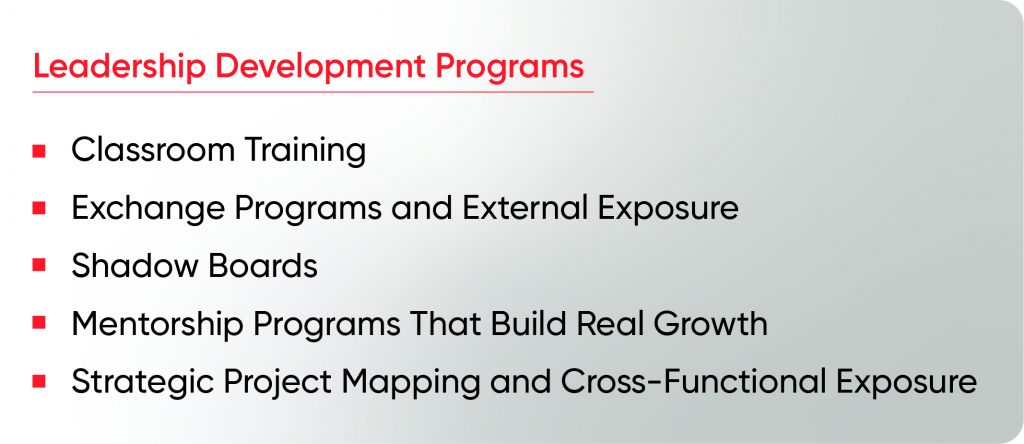
Top 5 Leadership Development Programs That Actually Work

Leadership development programs

The most effective Leadership Development Programs are not standalone initiatives. They are built through a combination of learning, exposure, and real-world responsibility. 

1. Classroom Training  

Classroom training still has a role, but only when it goes beyond theory. This is the most traditional kind of training program that not only provides knowledge but also changes behaviour. These are structured meetings focused on roles, responsibilities, strategic thinking, and emotional intelligence of an individual. Now, these sessions can be conducted in different forms and capacities.  

a. Tie-ups with External Programs (Sending People Out) 

Organizations can partner with institutions or curated learning experiences to expose employees to: 

  • New perspectives  
  • Structured leadership frameworks  
  • Cross-industry insights  

Employees are made aware of the industry’s best practices, structures framework, and a lot of other things that they can take back to their organization and implement in phases. Here, the real value does not lie in attending the sessions but in the post-learning application.  

b. Bringing in External Experts  

The other form of classroom can be inviting external experts into the organization, which allows learning to be: 

  • Contextual to business challenges  
  • Scalable across teams  
  • Interactive and discussion-led  

The major benefit of this form of training is that your employees will be able to gain outside perspective and knowledge. This will prepare them to deal with industry-related concerns.  

c. Focus on Behavioural Capabilities 

Modern leadership is behavioural, not just technical. Leadership today is about managing complexity, not just executing plans. The programs do not only focus on the skills required by an individual based on his or her job roles, but also on other basic skills that are required for leadership, such as: 

  • Agility – navigating constant change  
  • Resilience – sustaining performance under pressure  
  • AI-readiness – understanding how technology impacts decisions and teams  

2. Exchange Programs and External Exposure 

Leadership expands with exposure. Building a healthy pipeline requires exposure beyond your internal practices. Learning from experiencing how other people and organizations operate can lead to a different perception for your people, and this is how a company grows.  

a. Attending External Events 

Encouraging employees to attend industry events helps them understand emerging trends, learn from peers, and build external networks.  This exposure often translates into fresh ideas internally. 

Also Read: How Levels of Leadership Shape Workplace Culture

Great Place To Work is committed to bringing these experiences to you in the form of our biggest event, For All Summit, which takes place every year in February. Not only this, but we also conduct The Great Connects in different cities like Pune, Bangalore, Chennai, Delhi, and Ahmedabad to make networking more accessible for you.  

b. Sending Employees as Speakers 

This is a powerful leadership accelerator. When employees represent the organization externally, they build confidence, refine their thinking, and develop executive presence. It also signals trust, which in itself builds leadership behaviour. 

3. Shadow Boards  

A shadow board is a group of high-potential employees who work alongside senior leadership. This is one of the most impactful leadership development programs. The loop starts with identifying critical talent and bringing them into important conversations. 

By involving employees in key meetings, organizations enable them to understand strategic decision-making, see real business challenges, and contribute fresh perspectives. This is leadership development in its most authentic form, which is not simulated, not theoretical, but real. 

4. Mentorship Programs That Build Real Growth 

Mentorship programs are often practiced and seen as real growth builders. Companies often implement such programs but rarely optimize them to achieve the best outcome. 

a. Relatable Mentors and Coaches 

Before scheduling any mentorship program, the organization must decide on the group of people who will attend this program and what the intended outcome is. For example, if most of the people who’ll be attending this program are from the sales and marketing department, then the mentor should be a chief marketing officer or someone who has already served in a higher position in marketing. This is crucial because effective mentorship depends on alignment. Similarly, if the group attending the session is leaders from across the organization, then the mentor can be someone who can help them with critical thinking and decision making. The brownie point will be if he has worked in diverse industries at different positions, so that he is capable of guiding the people of different departments.

Also Read: What Great Managers Do Differently?

Moreover, a mentor should be approachable, experienced in relevant challenges, and capable of providing honest and actionable feedback. This could include internal leaders or external coaches. 

b. Combining Mentorship with Coaching 

Mentorship provides direction, and coaching builds self-awareness. Together, they help individuals reflect on behaviors, improve decision-making, and grow consistently over time. Leadership can’t be taught; it can be developed through reflection and feedback.   

5. Strategic Project Mapping and Cross-Functional Exposure 

Nothing builds leadership like responsibility. High-potential employees can be mapped to strategic initiatives, cross-functional projects, and business-critical challenges. This helps them understand the organization holistically, collaborate across teams, and make decisions with broader impact. This is where leadership capability becomes visible. Because leadership is not learned in isolation, it is learned through everyday action. 

What Makes Leadership Development Programs Truly Effective? 

Many organizations implement some of these initiatives. But effectiveness depends on how they are connected. Strong leadership development programs are: 

Continuous 

Leadership is built over time, not in isolated sessions. Therefore, one session will not do the needful; you’ll have to plan a series of sessions, which can be a mix of the above-mentioned programs as per your requirement.  

Experience-Led 

Real-world exposure matters more than theoretical knowledge. Therefore, you should consider external exposure and exchange programs as part of your L&D strategy for leaders.  

Behaviour-Focused 

Leadership is about how individuals show up, not just what they know. These training programs will not focus on an individual’s specific skill sets but on overall behaviour.     

Aligned with Culture 

Leadership development must reflect the organization’s values and expectations. Such programs should be designed to align with the organization’s culture because leaders are also culture makers.  

Reinforcing Leadership Through Recognition 

Leadership development does not end with programs. It is reinforced through everyday behaviours. Leaders repeat what organizations recognize. When behaviours such as: 

  • Inclusion  
  • Collaboration  
  • Ownership  
  • Innovation  

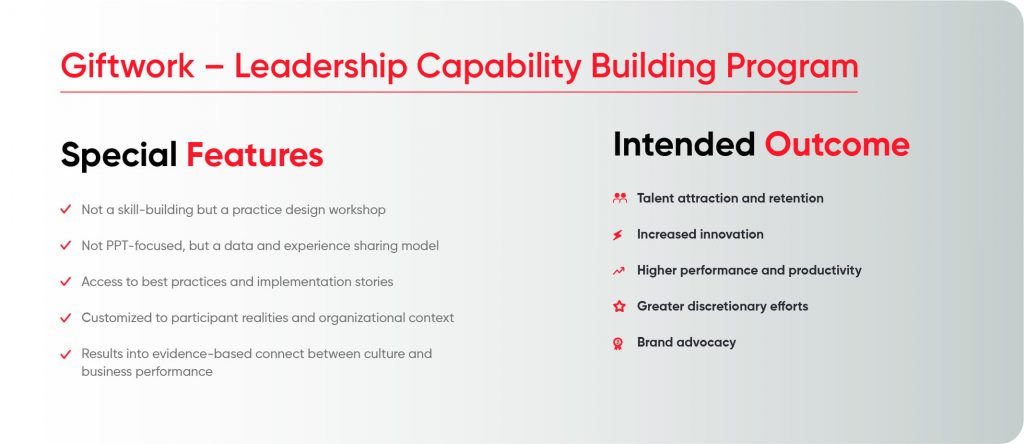
are consistently recognized, they become embedded in culture. This is where leadership capability-building programs like Giftwork® play a critical role. By enabling real-time, value-based recognition, organizations can reinforce leadership behaviours at scale, build a culture of appreciation, and make leadership visible across levels. Because leadership is not just developed in structured programs. It is strengthened in everyday moments.

leadership-building-capability-program

Conclusion 

Leadership development programs that actually work are not about sending employees to training. They are about building an ecosystem where leadership can grow. Organizations that succeed are the ones that identify potential early, provide meaningful exposure, create opportunities to lead, and reinforce the right behaviours consistently. Because leadership is not created overnight, it is built through experience, trust, and culture. 

Therefore, organizations that invest in building leaders don’t just strengthen their pipelines. They build great workplaces where people and performance thrive together. 

Frequently Asked Questions 

1. What are Leadership Development Programs? 

They are structured initiatives designed to build leadership capability, behaviour, and mindset within an organization. 

2. Who should be part of Leadership Development Programs? 

Next-in-line managers and high-potential critical talent should be prioritized for leadership development programs. 

3. What makes leadership development effective? 

In order to ensure the effectiveness of leadership development, there should be a combination of learning, real-world exposure, mentorship, and continuous feedback. 

4. How can organizations build future leaders internally? 

Future-ready leaders can be built by providing structured opportunities, strategic exposure, and reinforcing leadership behaviours through culture.

Human Resource (HR) management is an essential part of a business, as it helps manage people, who are among the most important resources. However, most businesses group the HR function with administrative functions rather than a strategic one.  

Today, businesses have recognized that HR plays a crucial role and the strategic value it brings to the business. At Great Place to Work®, our services enable organizations to understand how the HR function will influence the company’s growth trajectory. 

What Is a Broad Outlook of Overall HR Functions in an Organization?

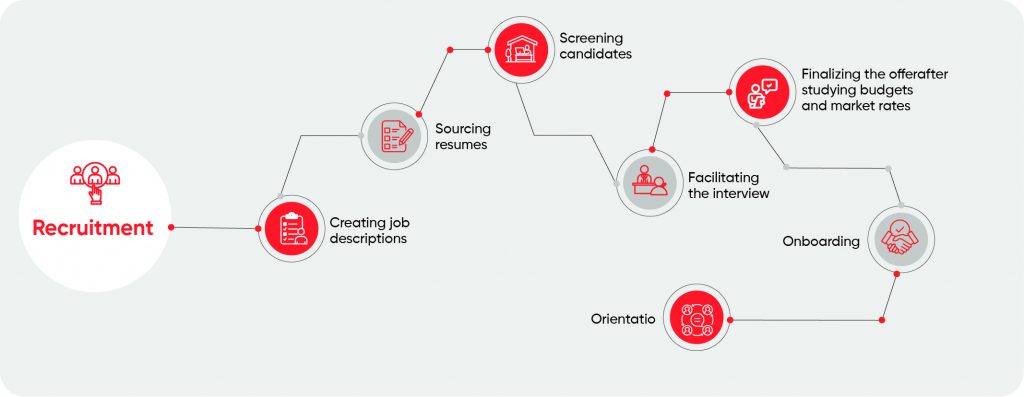
HR Recruitment
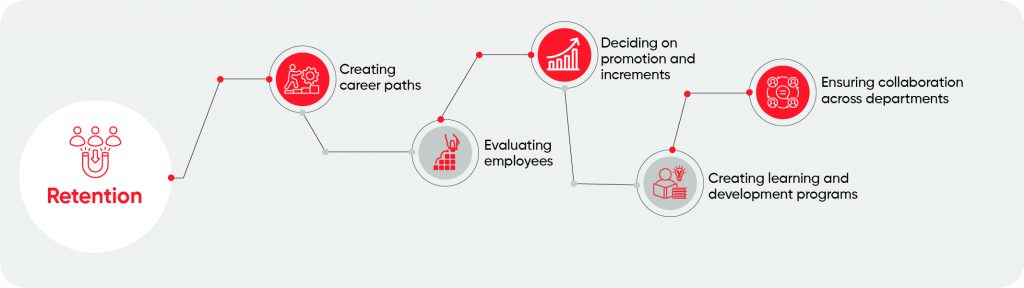
Employee Retention
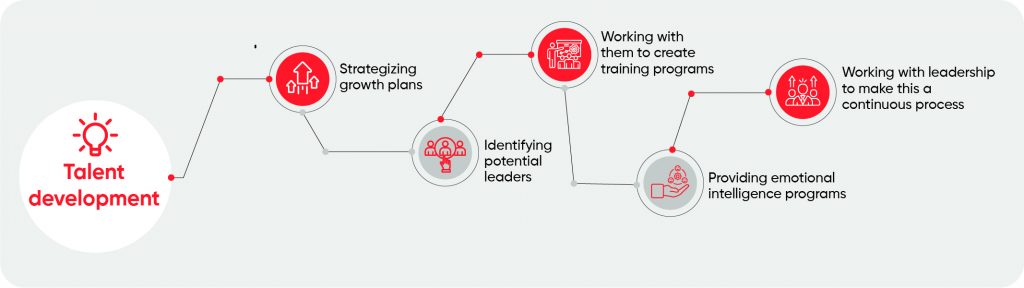
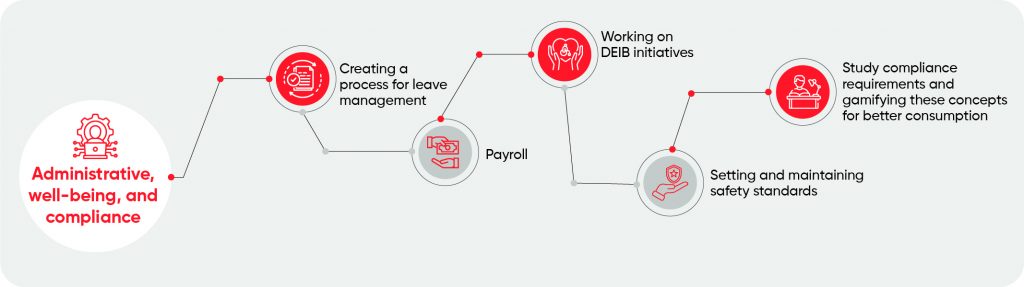
Talent Development
Administrative, wellbeing, and compliance

Which HR Functions Impact Business Outcomes? 

Having defined the overall functions of an HR department, let’s dive into the functions that specifically impact business outcomes. Here are some of the main HR-related responsibilities that impact business outcomes:

HR Responsibility What the Human Resource Department Does and How It Helps
Recruitment The HR department undertakes this process by talking to various stakeholders and understanding their needs. With smart recruitment, HR ensures that personnel with the right skill set and attitude join the company, keeping its operations running seamlessly.
Training and development As part of their responsibilities, the HR department understands employees’ changing needs and creates L&D programs to help them scale. With the right training, employees are prepared to meet challenges, and the company remains compliant with the local laws and regulations.
Employee engagement programs People need to be seen, heard, and appreciated in a work environment to continue performing well. The HR department identifies employees’ needs, designs engagement programs, and implements them to keep them motivated and engaged.
Manpower planning Planning for manpower requires a balance between people shortage and over-hiring to ensure continued operations and cost control. The HR department plans for manpower by understanding the business’s cyclical nature and ensuring the required staff is always available.
Planning and strategy contributions Today, decisions are not based on intuition or gut instinct, especially when it comes to human resources. The HR department maintains people-related metrics to support the leadership in strategic decision-making.


Below is a detailed description of each of these responsibilities and their impact on the company’s bottom line.

Strategic acquisition of talent 

The HR department plays a pivotal role in this aspect. They use their assessment skills to glean the skills and attitude of prospective candidates to ensure they fit the role. It is a role that involves keen observation, bargaining skills, and a deep understanding of business impact.

Impact on bottom line:  

  • High-quality hires ensure that the business remains productive and profitable.  
  • The company saves on hiring costs and can serve customers seamlessly. 
  • Having the right talent cuts down on further hiring costs due to referrals and better retention 

Learning and Development  

The HR department is responsible for identifying gaps in employees’ skill sets and creating programs to fill them. The right learning and development programs enable employees to upskill and help the company reduce hiring costs by filling the skill gap. Moreover, an excellent L&D program motivates existing employees to perform better.  

Impact on bottom line: 

  • Timely, compliance-driven training programs help protect data, improve skills, and ensure compliance with local laws. 
  • Employees are better prepared to deal with emerging technologies, such as AI, which helps the business stay competitive. 

Engagement, motivation, and retention 

In today’s hybrid work environment, with teams working across geographies, they must be engaged, motivated, and encouraged to do their best. The HR department provides the much-needed engagement to ensure that employees develop a sense of belonging and stay motivated. Employee recognition helps build a strong culture of appreciation. 

Impact on bottom line: 

  • Employee engagement results directly in better customer satisfaction, increasing customer lifetime value (CLV), and repeat business. 

Continuous workforce planning 

Many businesses today have cycles in which they need more employees and face a slack season when they can function with a skeleton team. It falls upon the HR team to plan for such situations, creating a mix that involves full-time, part-time, and gig workers. It involves a deep understanding of the business model, collaboration with leaders, and a strategic approach to workforce planning.  

Impact on bottom line: 

  • Ensures smooth operations across various seasons and cycles, keeping business expenses and revenues balanced. 
  • Proactive planning for workforce fluctuations future-proofs the business and enables it to compete. 

Data-driven decision-making 

Today, HR acts as the keeper of employee-related metrics, ensuring leadership makes data-driven decisions by identifying trends to plan for the future. Factors such as productivity, retention, hiring costs, and technology adoption costs can be considered when making decisions. 

Impact on bottom line: 

  • It becomes easier to balance the workforce by using data such as revenue per employee, the cost of an outside hire vs. an internal promotion, etc. 
  • Data-driven decision-making removes personal biases and ensures decisions for the best business outcomes.

How to Leverage the HR Department Strategically Going Forward 

It is a given that with the changing work scenario, HR will continue to play a strategic role in the growth and profitability of businesses. It is time to review the HR team and ensure they have the technology, tools, and leadership buy-in to enable their strategic contributions. Here are some steps to ensure that the business benefits from the HR department’s strategic inputs: 

  • Implement a culture of growth, learning, and meritocracy from the top down 
  • Enable frequent checks of the employees’ pulse to understand the way forward 
  • Invest in technology to ensure data-driven inputs from the HR department 
  • Understand training needs and enable the HR departments to create training material 

At Great Place To Work, the team helps by conducting impartial employee surveys, providing culture consulting services, and offering tailored solutions.  

Want to know how to take this forward? Click here to connect with our team. 

Frequently Asked Questions

What is the role of HR in ensuring business continuity? 

  1.  

HR helps business continuity by recruiting, training, retaining, and developing employees at all levels. HR can also support business continuity by ensuring the business meets compliance requirements set by local law, especially when operating in different countries. 

How does HR contribute to controlling costs? 

  1.  

HR can help a business cut costs at various levels. One is to hire the right people who will stay and grow with the business to cut hiring costs. Another way is to set a people-related budget for each department and ensure they stay within the limit. HR also regulates administrative, travel, and other related costs. 

Why is it important to empower HR to contribute to business? 

  1.  

The HR department manages one of the most crucial and dynamic resources of the business – employees. And when the HR department is empowered, it can do a good job of hiring, training, and retaining the necessary talent to keep the business running profitably. 

Can HR help businesses of all sizes? 

  1.  

Yes, HR is an important function for businesses of all sizes, though the way an HR department operates will vary by business type. In smaller companies, HR tends to function as administration and even finance, depending on the business. 

Which departments can HR help directly? 

  1.  

HR helps almost all departments directly, whether through hiring, ensuring discipline, controlling costs, or L&D. HR acts as a hub in most businesses by providing a structure for employees to work within.


Key Takeaways:

1. Trust is not a perk. It is the foundation that determines whether employees speak up for their organization or quietly disengage from it.

2. Leaders who practice transparency, fairness, and consistent care are the primary drivers of employee advocacy in any workplace.

3. Great Place To Work® research shows that high-trust cultures produce employees who are more likely to recommend their organization, go the extra mile, and stay longer. 

Consider the last time someone really recommended a workplace to a friend. Not because there was a form to fill out or a referral bonus on offer, but because something about the experience compelled them to tell others. A policy is not the source of that kind of advocacy. It comes from how a place makes people feel. 

In its simplest form, employee advocacy is when employees talk favorably about a company without being asked to do so. They tell their friends about it. In discussions, they defend it. On social media, they discuss their experiences. They become unofficial ambassadors because they sincerely care about their workplace, not because HR asked them to.

At the core of all of this is an evident fact that trust comes before employee advocacy, and then leadership is followed by trust.

What Is Employee Advocacy and Why Does It Matter? 

Employee advocacy is the voluntary promotion of an organization, its culture, its offerings, or its principles by its employees. This can occur informally through discussions, social media posts, recommendations, or just the way an employee discusses work during a family reunion. It can also occur formally through established programs. 

Employee advocacy has a big business impact. Professionals are seen as significantly more reliable sources than the marketing channels used by a company. One of the most reliable indicators for job seekers assessing a new employer is word-of-mouth from current employees. Stronger talent pipelines, improved retention, and a more robust employer brand are all characteristics of companies with high employee advocacy.  

However, it is important to note that advocacy cannot be created. It can serve as the foundation for marketing. Posts can be shared by colleagues. Referral initiatives can be started. However, unless the underlying experience is one that employees genuinely want to discuss, none of it results in true advocacy. More than anything else, the quality of leadership shapes that experience.

The Connection Between Leadership and Trust 

According to Great Place To Work, a great workplace is one where employees like colleagues, take pride in their work, and trust the companies they work for. Trust in leadership is the most fundamental of these three dimensions. 

“Management is honest and ethical in its business practices” is one of the best signs of overall trust, according to Great Place To Work research. The whole work experience changes when individuals feel their leaders are performing fairly; people feel more secure, they take chances, and raise their voices. Eventually, they have an emotional stake in the results.  

How Leaders Shape the Conditions for Employee Advocacy? 

Leaders shape employee advocacy by building a foundation of trust, visibility, and empowerment. Here are a few ways through which leaders can create conditions for employee advocacy:

1. Transparent Communication Builds Psychological Safety 

One of the most recurring trends in Great Place To Work Certified™ companies is that their leaders communicate honestly and clearly, particularly when topics are unclear. They don’t wait for flawless responses. They invite others into the conversation, contribute what they know, and own up to their errors. 

This type of openness has a significant impact by letting individuals know that they are trusted to share the truth. Additionally, people return the favor when they feel trustworthy. Employees progressively become active players in the organization’s story rather than passive spectators when leaders choose transparency over silence. Advocacy starts with the transition from observer to participant.  

2. Structured Advocacy Programs Work When Trust Already Exists 

One of the clearest signs of a high-trust culture is when companies can create official advocacy initiatives and have people actually embrace them, rather than ignore them as simply another corporate endeavor. 

One of the IT companies operates an employee ambassador program with a clear goal to prepare employees to communicate their organization’s story authentically. Participants are urged to engage with the company’s social impact initiatives, stay involved with its products, share industry perspectives, and be active on social media. In addition to helping the company attract top talent, ambassadors develop their personal identity, get specialized training, and become recognized as thought leaders.  

This program does not operate on a mandate. It functions because the underlying culture is one in which employees are already confident enough to speak up. And that pride didn’t just happen. Leaders who made the employees feel educated, appreciated, and invested in the company’s direction grew it consciously and continuously. What was always there was merely given form by the program.  

3. Recognizing Advocacy as a Contribution Creates More of It 

Leaders who openly praise employees for their advocacy provide a strong message: this company recognizes and appreciates those who go above and beyond to represent it. 

Through an exclusive Social Influencer Award, a mid-sized IT company has formalized this acknowledgment. Employees who actively increase the brand’s visibility, build relationships with customers and clients, and use their personal and professional networks to tell the company’s narrative are recognized with this award. The fact that this award is linked to quantifiable contributions – such as the production of original material, the quantity of posts shared, the reach attained, and the overall impact of their advocacy distinguishes it from a general appreciation program.  

By quantifying advocacy and formally recognizing it, the organization shows that it values the effort employees make to enhance its position in the marketplace. As a result, more employees are motivated to engage, and trust has increased. When something is acknowledged as valuable, others want to contribute to it.  

4. Fairness in Decisions Creates Loyalty That Speaks 

Even if a decision has no immediate impact on them, employees pay attention to the way it was made. When promotions seem to be based on merit, when pay structures are clear, and when policies are applied fairly across all levels and teams, these are signs that the company treats people fairly. 

Fairness is more than just a moral value. It increases trust. When employees see that things are fair all the time, they feel like they belong and are loyal to the company beyond their own interests. When they talk about the organization, they say “we” more than “they.”  

According to Great Place To Work data, employees who say their workplace is fair are much more likely to recommend it as a great place to work. This is the direct connection between fair leadership and employee support.  

5. Genuine Care for People Makes Advocacy Authentic 

Some leaders care about their employees’ well-being as a measure of success, while others care about their employees as people. The employees themselves can tell the difference right away. 

Leaders who ask how someone is doing and then listen to the answer. Leaders who see when a team member is overworked and step in before they burn out. Leaders who remember and celebrate important events in their lives. These times of real care build emotional connections that no wellness program or engagement survey can match.  

One of the most interesting findings that Great Place To Work observed is that employees who feel cared for by their managers are 3.7 times more likely to stay. But these employees are also some of the most vocal supporters of their company, which is more important than keeping them.  

6. Advocacy Does Not End When an Employee Leaves 

Perhaps one of the most overlooked dimensions of employee advocacy is what happens after someone exits. Most organizations treat the last working day as the end of the relationship. High-trust organizations treat it as the beginning of a different kind of relationship. 

One organization has established a formal alumni network on the stated philosophy that those who leave to explore other possibilities continue to carry the organization’s culture and legacy. They become brand ambassadors, potential future hires, business partners, and client referrals when they are respected both during and after their departure. Maintaining these connections also produces a dependable pipeline of rehires who are already familiar with the organization’s methods of operation, as culture fit and subject expertise become more crucial to business success. 

The network keeps former employees engaged with welcome letters when they join the alumni group, birthday acknowledgments, work anniversary notes, festive communications, and updates on key company accomplishments. Although the touchpoints are straightforward, they provide a strong message: people mattered here. 

As a result, those who have moved on still speak positively of the organization, refer others in their networks, and frequently visit again when the time is appropriate. This is the strongest type of advocacy. It isn’t driven by a current incentive or salary. It is motivated by the experience of receiving honest, dependable, and kind treatment. Only when leaders create that memory while the individual is still employed by the company does it exist.  

What High-Trust Cultures Look Like in Practice? 

Organizations that consistently appear on Great Place To Work Best Workplaces™ lists share several observable characteristics. 

  • Employees feel informed – They know where the company is going, why decisions are made, and how their role fits into the larger picture. Leaders at these organizations communicate frequently and honestly
  • Employees feel valued beyond their output – They are recognized as people, not just resources. Leaders invest time in development, well-being conversations, and genuine connections. 
  • Employees feel psychologically safe – They can raise concerns without fear of retaliation. They can make mistakes and learn from them. They can disagree with their manager and still feel respected. 
  • Employees feel pride – In their work, in their organization, and in the values that are actually lived day to day rather than printed on a wall. 

These are the conditions in which employee advocacy flourishes naturally. When people feel all of the above, they do not need to be asked to advocate. They do it because it is genuine. 

Employee Advocacy Is an Outcome, Not a Campaign 

The most significant change in perspective on employee advocacy is that it cannot be implemented. A social media toolkit, a hashtag, or a referral bonus cannot be used to create it; however, they can help with existing campaigns.

Also Read: What High-Performing Companies Do Differently?

The result is authentic advocacy. It results from a long-term culture of fairness, trust, empathy, and purpose. And every day, executives at all levels of the business either build or break that culture. When leaders prioritize transparency over spin, fairness over favoritism, genuine care over performative wellness, and specific appreciation over meaningless praise, they create conditions for employees to be proud of their workplace. The leadership formula for employee advocacy is simple. Companies that comprehend this will not just have stronger employer brands. They will have cultures that attract the right people, retain the best talent, and create something that truly represents their culture. 

Explore how Great Place To Work may assist you in creating a culture of employee advocacy through certification, cultural consultancy, and the Giftwork management development program.

Frequently Asked Questions

What is employee advocacy in the workplace? 

Employee advocacy is when employees genuinely promote their organization’s culture, values, or brand through social media, referrals, or everyday conversations. 

How does leadership impact employee advocacy? 

Leadership builds or breaks advocacy by fostering trust through transparent, fair, and supportive behavior. 

What is the relationship between trust and employee advocacy? 

Employee advocacy is driven by trust, employees who trust their leaders are more likely to recommend and speak positively about the organization. 

How can organizations measure employee advocacy? 

It can be measured using metrics like eNPS and employee surveys that track recommendation intent and overall sentiment. 

What role do managers play in employee advocacy? 

Managers shape daily employee experiences, making them critical to building trust and driving advocacy. 

Can advocacy programs work without a high-trust culture? 

No, without a strong culture of trust, advocacy programs lack authenticity and fail to deliver real impact. 

Organizations are currently experiencing a recent shift. Leaders are quickly implementing digital transformation roadmaps, automation trials, and AI tools. There has never been a better chance to create workplaces that are genuinely prepared for the future since systems are changing and capabilities are growing. What successful cultures look like in 2026 will be determined by the CHROs who make the most of this opportunity and match company goals with people strategy.

The role of the CHRO has never been more consequential. The choices HR directors make this year will determine whether their companies create cultures that draw in, nurture, and retain top talent for years to come as AI transforms job roles, generational changes redefine workplace expectations, and the boundary between work and wellbeing continues to change.

This piece is not about theoretical frameworks. It is about the real priorities that CHROs across industries need to act on today, grounded in research from Great Place To Work® India’s Workplace Culture Outlook 2026 report. If you are looking for clarity on where to focus your energy and resources this year, this blog will give you clarity.

Download Workplace Culture Outlook 2026 report

What is an HR Strategy? 

An HR strategy is a plan that an organization employs to connect its people practices with its overall business objectives. It discusses how a company finds talent, nurtures it, keeps it, and fosters an environment where employees can regularly give their best. In contrast to daily HR operations, which concentrate on hiring workflows, payroll, and compliance, an HR strategy is even broader and covers important issues. What type of culture are we creating? What skills are we going to need in the future? How can we ensure that the practices of our employees align with the direction of our company?

Workforce planning, leadership development, employee experience, and DEIB (Diversity, Equity, Inclusion, and Belonging) are all included in a well-designed HR strategy. When done correctly, it serves as a bridge between the business goals and the real experiences of its employees. That connection is more important than ever in 2026. Businesses that create the link between strategy and real-world experience are the ones that create workplaces where employees truly want to show up, contribute, and develop. CHROs are in the best position to take the lead on this actual opportunity.  

How to Build a Future-Ready HR Strategy in 2026? 

Building a future-ready HR strategy does not entail adding new programs to an already packed HR calendar. It is about making more informed decisions and focusing on what would truly benefit people and organizations. Here are a few priorities that must be included in a future-ready HR strategy: 

1. Address Career Anxiety with Clarity and Confidence 

One of the most essential things CHROs can do right now is provide employees with a clear, confident response to a question that everyone is thinking about: what does my future look like in this organization, and what role does AI play in it? 

Also Read: Human Rеsourcеs Activitiеs for Employееs in 2026

According to Great Place To Work India’s report, 6 out of 10 organizations are now reporting a decline in employees eager to go the extra mile, a trend that has been accumulating for three years. The key driver is career anxiety, which stems from ambiguous expectations, rapid reskilling demands, and uncertainty about the future of specific professions.  

The good news is that clarity is one of the most effective tools accessible to HR professionals. Employees’ confidence and engagement increase significantly when they understand how their jobs are growing, what skills the business will help them develop, and what growth possibilities are available. CHROs should invest in structured listening tools such as pulse surveys, town halls, and skip-level talks to identify areas of doubt and then respond transparently and purposefully. 

Organizations that rapidly explain their AI adoption roadmap, coupled with a corresponding people-readiness plan, are already witnessing increased engagement. Employees do not fear change if they feel supported during this transformation. That is the opportunity HR executives have right now: to replace uncertainty with direction, fear with genuine confidence in the future.  

CHROs can actively work to restore a sense of forward momentum in addition to listening. This could take the form of creating “ask leadership anything” forums where employees can voice concerns and get frank, helpful responses, holding team-level discussions about how work is changing and what that means for growth, or publishing career pathway guides that include AI-augmented roles. Employees put out their best effort when they feel heard, recognized, and guided.  

2. Build AI-Enabled Career Pathways That Inspire, Not Intimidate 

Careers with AI capabilities are no longer a benefit in 2026. They serve as a standard expectation for all industries. Individuals are far more likely to put in their best effort at work if they feel ready to work with AI technologies; their jobs have been properly repositioned in this new context, and they can see a feasible growth path ahead of them. 

This means that CHROs need to provide relevant reskilling pathways rather than just generic upskilling initiatives. These are career paths that are directly related to an employee’s particular position, industry, and the organization’s future direction over the next two to three years. The study found that when compared to peers, Best Workplaces™ report 7% higher experience scores on career progression, team chemistry, and expectations clarity. These three are the main factors that decide whether professionals will put in their best effort or not.  

The best strategy blends visible internal mobility with structured learning. Employees’ enthusiasm changes when they witness colleagues advance within the company, when they see their own abilities growing in ways that feel pertinent and appreciated, and when leadership communicates career opportunities with precision rather than ambiguous promises. When people think the company is investing in them, they make investments. 

The way that job descriptions are being modified to reflect the AI-augmented nature of employment should also be examined by CHROs. Jobs that formerly required manual data processing increasingly call for strategic thought, judgment, and interpretation. It sends a strong message that the company views its employees as collaborators in development rather than expenses to be controlled when that evolution is made clear, and training is developed around it. One of the most exciting changes an HR executive can make is to reframe employees as strategic participants using AI rather than as recipients of AI.  

3. Embed Wellness Into Everyday Leadership Behavior 

Many organizations have established excellent wellness initiatives, including employee assistance platforms, mental health days, mindfulness resources, and physical health subsidies. These are truly worthwhile. However, research repeatedly demonstrates that an employee’s rapport with their immediate boss has a greater influence on their sense of well-being at work than any policy.

Also Read: HR Policies That Build a Stronger Organization

According to Great Place To Work, leaders who listen carefully, pose insightful questions, and relate their team’s work to a larger goal increase employee retention by 3.7 times. That is a substantial return for a behavior that requires only sincere care and attention, with no extra funding.  

This significantly reframes the wellness goal for CHROs. The objective is to create a management culture where health is evident in day-to-day interactions rather than merely putting policies in place. This entails frequent check-ins that go beyond project status updates, timely and intimate moments of acknowledgment, and discussions where staff members feel truly heard rather than controlled. 

A greater investment in manager enablement is the practical impact for HR strategy. One of the most effective things a CHRO can do is train managers to have better discussions, identify indicators of stress or disengagement, and foster psychological safety within their teams. When managers do this correctly, health is integrated into the culture instead than being a supplemental initiative.  

It is also worth recognizing the compounding effect that strong manager-employee relationships have across the business. Teams with high-quality management relationships report better collaboration, stronger innovation, and lower attrition. Wellness, in this light is not just a people issue. It is a performance issue, and investing in it at the management level pays returns across every part of the organization. 

4. Design Flexibility Around Autonomy and Real Choice 

Flexibility has moved from being a competitive perk to a baseline expectation for most of today’s workforce, particularly among Gen Z employees and gig colleagues who are reshaping what work norms look like across industries. In 2026, the question is no longer whether to offer flexibility. The more meaningful question is how to design flexibility that genuinely serves people across different life stages, work styles, and personal circumstances. 

Employees today are less focused on where they work and more focused on how much control they have over their work, their growth, and their time. That distinction matters for CHROs. A flexible work policy that only addresses location without addressing autonomy over how work gets structured and delivered will miss the deeper need that employees are expressing. 

The report highlights a notable paradox worth paying attention to: while millennials report high access to learning and resources, 1 in 5 still does not experience job security, particularly in sectors like IT and Biotech. Access to opportunity and psychological security are not the same thing. An effective HR strategy in 2026 addresses both, making sure that the pathways to growth are genuinely accessible and that employees feel stable enough to pursue them confidently. 

The leadership challenge here is one of the thoughtful balances. CHROs need to help their organizations design flexibility frameworks that are fair across different functions and seniority levels, that support accountability without surveillance, and that allow for personalization without inadvertently creating inequity. When flexibility is designed well, it becomes one of the most powerful retention and engagement tools available. Employees who feel trusted to manage their own work are more likely to bring their full capabilities to it. 

5. Elevate DEIB from a Commitment to a Measurable Culture Priority 

In recent years, DEIB has been a strategic focus for businesses, and in 2026, the direction of progress is becoming evident. Organizations that have moved from considering DEIB as a stand-alone project to integrating it into daily culture assessments, people management, and leadership development are the ones that are making progress. 

According to a research carried out in India by Great Place to Work, 6 out of 10 CHROs think that the best method to progress DEIB in reality is to create inclusive leadership capabilities. This is a significant and inspiring realization. Inclusion manifests and expands in everyday leadership behavior: who is invited to speak in a meeting, who gets sponsored for a stretch assignment, who feels safe to speak up, and who feels genuinely valued by their team.  

The data also reveals significant room for growth and for celebrating progress where it is happening. Only 45% of CHROs feel there is scope to formally embed DEIB into their organization’s core values and principles. 2 out of 3 report that less than a quarter of their leadership teams include individuals from historically excluded groups. And only 5 out of 10 CHROs are tracking retention across diverse employee groups, which means most organizations have an important opportunity to build better measurement into their DEIB strategy. 

For CHROs building strategy in 2026, the path forward is to close the gap between intent and accountability with confidence and optimism. This means setting specific inclusion goals for leadership teams, building DEIB metrics into manager performance expectations, creating safe and structured channels for employee feedback on inclusion experiences, and regularly reviewing hiring, promotion, and retention data through a DEIB lens. Organizations that do this well do not just check out a compliance box. They build cultures where diverse thinking drives genuine innovation and lasting competitive advantage. 

Common Challenges and How to Overcome Them 

Here are a few common challenges that CHROs are facing, along with the steps to overcome them: 

Challenge 1: Rebuilding Discretionary Effort Across Teams 

According to research from Great Place To Work India, organizations where all employees have a favorable work environment report 9% more discretionary effort than their peers. This effort is driven by trust, clarity, and acknowledgment. CHROs should conduct audits to determine whether senior leadership is actively fostering trust through open communication, whether managers set expectations that make employees feel capable, and whether recognition is timely and meaningful. People naturally contribute more when these foundations are secure.  

Challenge 2: Investing in Manager Capability as a Strategic Priority 

Manager development is frequently ignored, despite the fact that everyday interactions between managers are the most important factor in determining whether team culture is developed or not. By creating structured coaching programs, integrating recognition into management routines, and making managers responsible for the caliber of their employees’ experiences, the most progressive CHROs are establishing it as a fundamental business investment. Culture is evident everywhere, every day, when managers lead well.  

Challenge 3: Making AI Adoption a Positive, Human-Centered Transition 

The CHROs that successfully lead AI transitions are those who combine technology rollouts with a compelling human readiness narrative, assisting staff in viewing AI as a tool that enhances rather than replaces their creativity and judgment. The practical approaches are simple: openly communicate the AI roadmap, provide role-specific reskilling, and establish internal forums where colleagues can discuss their successful use of new tools. Businesses that take this approach are already witnessing increased creativity and engagement.  

Challenge 4: Making Inclusion Real at Every Level of the Organization 

The genuine cultural effort takes place in bridging the most prevalent DEIB gap between frontline manager behavior and senior leadership commitment. CHROs should establish peer accountability within teams, make inclusion a stated expectation in leadership development programs, and make sure DEIB measures are discussed in regular business meetings rather than being saved for yearly reports. At the leadership table, inclusion data receives the attention and urgency it merits when it is presented alongside performance statistics.  

Conclusion 

The organizations that lead with trust are the ones that will determine what success looks like in 2026. Not just technology, not only the effectiveness of the method – it is about trust. This means being open and honest with employees about how their roles and careers are changing, giving managers the tools they need to foster real human connections in the workplace, creating flexibility that respects people’s personal lives, and incorporating accountability into inclusion commitments to make progress quantifiable and apparent. 

This is well-supported by research from Great Place To Work India, which shows that companies with strong levels of trust consistently report higher levels of discretionary effort, better retention, and more resilient cultures. These are competitive advantages that directly affect an organization’s reputation and business outcomes.  

In 2026, CHROs will have a lot of real opportunities. The framework for creating outstanding workplace cultures is in place. Tools, data, and organizational awareness have never been more aligned. Going further into the most important areas – clarity, trust, inclusivity, and leadership capacity is currently the top focus. Everything else will follow if you get those properly.  

Frequently Asked Questions 

How can CHROs prepare for AI-driven team? 

By focusing on reskilling, transparent communication, and building a learning culture where employees feel confident using AI tools. 

How will technology impact HR strategies in 2026? 

Technology will shift HR toward strategic priorities like culture, leadership, and employee experience, supported by AI-driven insights and analytics. 

What are the biggest HR challenges expected in 2026? 

Key challenges include managing career uncertainty due to AI, leading hybrid work cultures, and ensuring consistent, measurable DEIB outcomes. 

What role does employee experience play in future HR strategies? 

Employee experience will be central, directly influencing retention, engagement, productivity, and overall employer brand. 

What are strategic HR initiatives? 

They are structured, outcome-focused programs aligned with business goals, such as AI reskilling, leadership development, flexible work models, and DEIB initiatives. 


Key Takeaways:

1. Inclusive leadership is a business strategy that helps generate revenue from new products and enables better business decisions.

2. The foremost effect of inclusive leadership is fostering an environment of safety in which people perform at their fullest potential.

3. Inclusion comes from consistently enabling people to be their true selves through active listening, encouraging inclusivity in daily work, and practicing through actions. 

In today’s competitive world, businesses are looking for ways to gain a competitive advantage over others. One way to do that is with inclusive leadership. Until a few years back, inclusivity in the workplace was a good-to-have factor that most companies showed insincerity to.  

However, in today’s world, DEIB (Diversity, Equity, Inclusion, and Belonging) forms the foundation of growth and profitability for businesses. As per the report on the State of DEIB in 2025, ‘Organizations are moving beyond symbolic actions toward structural change, prioritizing fairness in access and opportunity. Data from our Great Place To Work® Voice of CHRO survey suggests that 64% of CHROs report a strong sense of belonging across their organizations, signaling a shift toward cultures of equity, inclusion, and shared growth.’  

The Great Place to Work® team works with its customers to understand where an organization stands on DEIB initiatives and helps them implement the right measures.

What Does Inclusive Leadership Mean? 

Inclusive leadership is a proactive approach that ensures diversity is part of the organization’s DNA. With a top-down approach, an inclusive leader helps all team members, regardless of gender, orientation, age, disability, or other factors, feel respected, valued, and included. They ensure that all voices are heard, an atmosphere of encouraging inputs is maintained, and that diverse perspectives are welcomed.  

To be effective and inculcate a culture of inclusivity at every level, an inclusive leader will display the following traits: 

  • Committed to inclusivity: As a leader, the inclusive leader will actively and consciously demonstrate their commitment to making inclusivity a priority. 
  • Courage to question: Inclusive leadership will need leaders who dare to question what is happening, examine the status quo, and hold themselves responsible, where required. 
  • Recognize bias: An inclusive leader will evaluate their personal biases, study organizational biases, and work to create processes to mitigate them. 
  • Be voraciously curious: Inclusive leadership is based on curiosity, open-minded listening, and seeking input from all levels of the organization. 
  • Culturally aware: Building on their curiosity to learn about others, an inclusive leader will learn about other cultures and show sensitivity in situations involving cross-cultural interactions. 
  • Collaborate continuously: As an inclusive leader, it is crucial to collaborate with others and encourage teams across the organization to do the same. 

Inclusive leadership brings a host of benefits that influence both short and long-term aspects of a business.  

Improved employee commitment 

Employees are more committed to the organization when they feel accepted, included, and valued. Inclusive leaders ensure they listen to employees’ input without bias, accept suggestions, and appreciate their work. This results in improved productivity, reduced absenteeism, and better retention rates. 

Inclusive and better decision-making 

When an inclusive leader leads a team, team members are likely to feel comfortable enough to share their unique perspectives. This, in turn, results in informed decisions, out-of-the-box solutions, and better business outcomes.  

Innovative approach to problem-solving 

People from different backgrounds, ages, and experiences approach the same issue from different angles, which can lead to unique solutions to business problems. Inclusive leadership encourages people to be innovative and to develop diverse solutions that benefit the organization. 

Positive impact on the company’s image 

A company that is truly committed to inclusive leadership is more likely to launch new products, move into new territories, and offer unique solutions to existing problems. By doing so, the company will gain a reputation for offering excellent products or services and for being an excellent employer, attracting customers and top talent.  

Enhanced financial performance 

Businesses with inclusive cultures often have a stronger presence in the market and can keep up with changing market needs. As a result, they often see an uptick in revenue, a consistent increase in market share, and improved customer satisfaction.  

How Does Inclusive Leadership Encourage Innovation? 

The foundation of innovation in any field is the ability to develop diverse approaches, and inclusive leadership lays the groundwork to enable this. Inclusive leadership encourages people at all levels and from all backgrounds to think differently and contribute their input.  

When this happens, innovation results as employees have the freedom to challenge the status quo, seek new opportunities, and offer creative solutions.  

With inclusive leadership at all levels, the company can ensure that: 

  • Ideas are not limited to a particular department or hierarchy 
  • Employees feel secure enough to share their ideas and take risks 
  • People have the wherewithal to collaborate across the organization 

Inclusive leadership weaves innovation and participation into the organization’s culture rather than treating them as forced initiatives. Different levels of leadership shape workplace culture in different ways. 

What Are the Best Practices to Build Inclusive Leadership? 

The culture of an organization permeates from the leadership level to the rest of the organization, and the best practices for building a culture of inclusive leadership start at the top. 

Emotional intelligence workshops 

Set up and offer emotional intelligence workshops to people at various levels. Work on aspects like active listening, recognizing unconscious bias, and inclusive communication. Running workshops like this regularly, or gamifying these concepts, will help people work toward becoming more inclusive. 

Create safe channels 

Employees are often not forthcoming about their ideas and feedback because they fear rejection, repercussions, or mockery. Ensure that your company has safe spaces, people, and channels where people can offer their input. Allow people to acknowledge and learn from their mistakes as required. 

Inclusive decision-making 

Inviting diverse perspectives, encouraging participation, and removing barriers, such as hierarchy in decision-making are great ways to ensure inclusive leadership. 

Feedback loops 

Check the pulse of employees through regular surveys and town hall sessions to encourage people to share their feedback. Collate the feedback, pinpoint the aspects to be implemented, and share it with the larger team. 

Rewards and recognition 

Establish a rewards program to recognize people who have offered unique perspectives that have resulted in success. Recognize contributions both at the individual and team levels.

Impact Measure Importance
Brand perception Employee and customer surveys Helps in talent retention and improving Lifetime Customer Value (LCV)
Innovation and product launches Product feedback and customer complaints Offers insights into where the company is lagging and areas for improvement.
People outcomes A mix of people from different backgrounds, and how well they feel supported Talent acquisition and ensuring that performance is on the uptick

How to Leverage the Benefits of Inclusive Leadership?

In conclusion, businesses need to realize that inclusive leadership is not an option but a critical aspect of their growth strategy. It is about ensuring that people from all walks of life feel valued, secure, and motivated to perform at their best. At Great Place To Work, the team helps companies transform their culture with culture consulting services.  

Want to know how to take this forward? Click here to connect with us 

Frequently Asked Questions

Why is inclusive leadership crucial for the growth of a business?

Inclusive leadership makes it easier for a company to attract and retain the top talent in the industry, meet customer expectations, offer innovative products, and maintain a good public image.

What is the first step to becoming an inclusive organization?

The first step to becoming inclusive is recognizing and acknowledging that talent is not limited to a particular age, gender, or type of person. Making it part of your company policy to accommodate people from all walks of life based on their talents or skills, and to offer them a good working environment, also helps.

How does inclusive leadership help us become profitable? 

    With inclusive leadership, the company becomes more innovative, solves problems, and ensures continuity. This, in turn, lowers costs, expands the customer base, and builds a positive market reputation, making the company profitable.

    Whose responsibility is ensuring inclusive leadership? 

      While the process of ensuring inclusive leadership starts at the top, it is the responsibility of everyone in the organization to ensure an inclusive environment.  

      Is inclusive leadership a one-time exercise or a continuous process? 

        Inclusive leadership is a continuous process in which every member of the organization commits to working hard to overcome biases and become more inclusive.

        Key Takeaways:

        1. Employee feedback plays a vital role in ensuring team engagement and improving overall productivity

        2. Regular, two-way feedback helps employees feel valued, understood, and connected to the organization’s mission.

        3. When companies actively seek and act on feedback, they build transparency, and strengthen relationships across all levels.

        Workplaces are changing to keep up with the evolving technology landscape, and in recent years, it has become clear that employee engagement lies at the core of a stable work environment. And organizations that want to engage with their employees must understand that they need two-way communication, listen to what they have to say, understand what they want, and the key to that is employee feedback. 

        A 2025 report from Great Place to Work® found that ‘Employees are twice as likely to report elevated levels of trust when management actively solicits and responds to suggestions and ideas.’ 

        With employee feedback, organizations get closer to understanding what drives their employees and, in turn, can help employees feel engaged and motivated.

        What Does Employee Feedback Mean?

        Employee feedback is the process by which a company and its employees exchange productive, relevant, and timely information. This information can relate to performance, concerns, and plans. The exchange of information or employee feedback can be either through official channels like regular performance reviews, employee surveys, town halls, etc. It can also happen through informal channels like chats, conversations, or through the exchanges that happen in corridors and on calls.

        According to a 2025 report from Great Place To Work India, ‘Approximately 79% of employees feel that management genuinely seeks and responds to input and involves staff in decision-making. In Best Workplaces, this figure rises to 86%.’ 

        Great Place To Work’s Emprising™ portal helps you take the survey and listen to your employees. This data will give you a direction to build a workplace culture that works for all

        How Does Employee Feedback Impact Engagement?

        When a company sets up easy, regular, and two-way channels for employee feedback, it makes the employees feel valued and heard. When there is regular feedback between leadership and employees, the team understands the company’s broader purpose, mission, and vision, as well as their roles and responsibilities.

        When the company empowers two-way feedback, then you can see benefits like:

        • Employees understand the company’s expectations from them
        • A constructive feedback loop to understand improvement areas
        • Creating a setup where good performance is recognized and appreciated
        • Improvement in the company’s image as a stellar employer that encourages feedback
        • Trust creation with stakeholders (employees, customers, shareholders, vendors, authorities, etc.) 

        As per the Great Place To Work India 2025 report, ‘Approximately 79% of employees feel that management genuinely seeks and responds to input and involves staff in decision-making. In Best Workplaces, this figure rises to 86%.’ 

        ‘Across various industries, biotechnology and pharmaceuticals, professional services, and information technology report lower positive employee responses, while retail, manufacturing and production, construction, infrastructure, and real estate present the highest rates at roughly 82%.’

        What Are the Benefits of Acting on Employee Feedback?

        From the above segment, it is easy to see that employee feedback impacts the organization when done right. In this segment, we will dive a bit deeper to understand the specific benefits of employee feedback, what high-performing companies do differently, and how this impacts the organization.

        Benefit #1: Performance improvement

        Employees are more committed and perform better when a company conducts regular performance reviews, shares feedback, and provides resources that help them improve. With a bit of positive reinforcement, there can be a big difference in how employees perform. 

        Benefit #2: Engaging employees 

        When the organizations take the time to provide constructive feedback and the means to improve, employees feel engaged and are more likely to be more committed to their work and the organization’s goals.

        Benefit #3: Improved decision-making

        With regular input from various teams, leadership has insights into what people think, want, feel, and can make effective decisions supported by updated data. Knowing the pulse of the employees helps leadership design policies that work.

        Benefit #4: Empowered employees

        When employees have a complete view of the leadership’s perspective, regular feedback, and the means to provide feedback to the leadership, they feel motivated and empowered. Whether it is career planning, shared goals, or skill development, employee feedback supports all this. 

        Benefit #5: Talent retention

        When there is an established feedback process that works both ways, employees feel heard and supported and are less likely to leave. Companies with a well-established feedback process can attract and retain the best talent, ensuring continued quality in their products and services.

        What Are the Different Types of Employee Feedback?

        The type of feedback systems a company has depends on factors such as size, business type, number of employees, employee demographics, and overall management style. However, the following are the most common types of feedback.

        #1: Structured 

        This kind of feedback is given to employees periodically at regular intervals to assess their performance, track their achievements, and offer corrective support. Most organizations have only an annual review, while others may schedule reviews and discussions at regular intervals. Many leading companies also gather employee evaluation feedback through employee surveys, where employees are asked to rate how they feel about various aspects such as their job, career path, HR initiatives, and other factors.

        #2: Impromptu

        This kind of employee feedback is on an informal basis and could be as simple as a chat. In many cases, the feedback is collected when an incident occurs or a need for discussion arises due to changes in the team. Many companies collect employee feedback during the exit process or during training sessions.

        #3: 360-degree

        With this kind of feedback, the company will collect feedback not only from employees but also from all stakeholders, including internal teams, clients, customers, vendors, suppliers, and other sources.

        #4: Peer level

        In many companies, peers have the opportunity to provide feedback to one another. This is often seen as an opportunity for various teams to collaborate better. One such example is when the marketing and sales teams provide feedback about each other. 

        #5: Manager assessment

        Team members are encouraged to evaluate their managers on various factors, often anonymously, to ensure fairness. This kind of employee feedback is useful for checking the pulse of team members and ensuring that operations are running well.

        How to Enable Effective Employee Feedback?

        Today’s organizations, with their mix of generations, understand the need to provide a platform to empower employees to give and share feedback with peers, within the team, with leadership, and with others. However, employee feedback becomes more effective when a few best practices are kept in mind.

        Best practices for enabling effective employee feedback are:

        • Provide feedback on a timely basis when it is event or behavior-based
        • Set regular schedules for performance evaluation and follow them
        • Be very specific in your feedback and back it up with numbers where applicable
        • Encourage two-way communication between the evaluator and the assessee
        • Focus on positives or ways to improve performance rather than criticism
        • Set the pace in a way that ensures employees feel comfortable getting and giving feedback
        • Record and file feedback sessions with explicit permission from both parties

        How to Implement an Effective Feedback Process?

        When a company begins developing an effective employee feedback process, it is crucial to gather input from leadership and key personnel. Here are some steps to ensure an effective employee feedback process:

        1. Identify the objective: Ensure complete clarity on what the feedback process is supposed to achieve before starting.
        2. Get buy-in from leadership: Leadership buy-in is important to ensure that employees see the need for the feedback mechanism.
        3. Select the right tools: With diverse teams spread across geographies, it is vital to have an easy-to-use tool or platform to collect, store, and share feedback.
        4. Educate managers and employees: Train those who need to use the system well. Enable access to people on a need-to-know basis.
        5. Set periodic feedback cycles: The feedback process becomes faster and more effective when a schedule is established for employees to give and receive feedback.
        6. Implement action points from employee feedback: After the employee feedback process is complete and action items are finalized, implement the changes. This will increase people’s belief in the feedback system.

        How to Make the Most of Employee Feedback?

        Employee feedback is an essential part of an organization’s growth strategy as it focuses on one of the most important resources – its people. Ensuring that people in the organization have a safe space and a cohesive system for providing and receiving feedback is of utmost importance. This is where Great Place To Work can help. Whether it is conducting impartial employee surveys or providing culture consulting services, Great Place To Work can offer tailored solutions. 

        Want to know how to take this forward? Click here to connect with us

        Frequently Asked Questions

        What are the best ways to collect employee feedback?

          Companies can collect employee feedback by both formal and informal means. The formal methods for collecting employee feedback include surveys, formal assessment discussions, and intranet forums. The informal methods include chats, discussions, and feedback forms.

          Why is employee feedback important to improve employee engagement?

            Employee feedback offers insights into what employees are feeling and provides input on the next steps to mitigate concerns, if any. Feedback also makes people feel heard, understood, and valued. All these factors help with employee engagement.

            How does employee feedback help with employee discipline?

              Employee feedback regularly assesses gaps between employees’ actual and expected performance. This, in turn, helps the company offer constructive discipline, including training and resources to improve performance.

              How does employee feedback help in talent retention?

                When employees have the means to share their thoughts, and this leads to transparent and fair processes, it improves employee morale, which in turn leads to talent retention.

                What is the role of employee feedback in ensuring a good public image?

                  When all stakeholders believe that the company values a fair process for feedback and corrective action, this can improve morale, leading to a better public image.

                  Workplace dynamics are constantly shifting from year to year. However, the one constant that determines whether an organization will advance or struggle in silence is human behaviour. Employees now have more flexibility due to hybrid work, but leaders now face additional challenges. When employees aren’t always experiencing work in the same way, how can managers maintain culture, foster collaboration, and establish trust? While some employees work remotely, others are in the office. While some people feel disconnected in the absence of regular interaction, others flourish due to new bondings. In this reality, policies alone are not enough to create a workplace culture, a lot depends on the manager’s capability.

                  This is precisely why organizational behaviour is more significant today than in conventional office models. It helps leaders figure out how people think, act, deal with change, make decisions, and add value to changing work environments. In a hybrid workplace, culture is no longer just a mere concept. Intentional leadership, communication habits, team norms, and daily experiences all help to strengthen it.

                  What Is Organizational Behaviour in Today’s Workplace?

                  Organizational behaviour is the way of understanding how individuals and teams behave within an organization. It is about how they communicate, collaborate, respond to leadership, handle conflict, and stay motivated.

                  But in today’s workplace where hybrid culture is becoming the new norm, organizational behaviour has come out of the textbooks. It is becoming a practical leadership lens. It helps you get answers to a lot of questions, such as: 

                  • Why do some teams stay highly connected even when they are miles apart?
                  • Why do some employees feel invisible in hybrid setups?
                  • Why do some managers create trust while others create uncertainty?

                  Modern organizational behaviour sits at the intersection of:

                  • Employee psychology
                  • Leadership style
                  • Communication systems
                  • Decision-making patterns
                  • Workplace culture

                  As hybrid work becomes the norm, understanding these behaviours helps organizations design workplaces that work for people, not just processes.

                  Organization Behaviour in Hybrid Work Model

                  Hybrid work has changed where people work. It has also changed how people experience work. In the hybrid working model, a number of leaders have found that their personal productivity remains stable or improved but also identified clear challenges around culture, collaboration and team unity. This gap really matters. Because even while trust, belonging, and informal learning begin to weaken, productivity can still remain the same but not for very long. Through organizational behaviour, you can notice such signals early. This shows leaders that:

                  • Silence in meetings may indicate reduced psychological safety
                  • Faster task completion does not always mean stronger engagement
                  • Flexibility without clarity often creates inconsistency
                  • High autonomy without inclusion can increase disconnect

                  In short, hybrid work demands deeper behavioural understanding because visibility is lower, but expectations remain high.

                  Key Benefits of Organizational Behaviour in a Hybrid Workplace

                  In hybrid setup, organizational behaviour has become important and has a lot of benefits:

                  1. It Helps Build Trust When Visibility Is Low

                  In physical workplaces, trust often develops through daily interaction. But, in hybrid environments, trust must be built intentionally. When leaders understand behavioural patterns, they become better at creating trust through clarity, listening, and follow-ups. In the meantime, trust remains the foundation of a high-performing culture. Employees now judge leadership less by presence and more by consistency:

                  • Do managers communicate clearly?
                  • Are expectations fair across remote and office employees?
                  • Are decisions transparent?

                  2. It Prevents Proximity Bias

                  One of the biggest hidden risks in hybrid work is proximity bias; when employees who are physically present receive more visibility, opportunities, or influence. Organizational behaviour helps leaders recognize these unconscious patterns. But, without that awareness:

                  • Remote employees may contribute equally but feel overlooked
                  • Recognition becomes uneven
                  • Development conversations happen informally only with visible employees

                  A strong behavioural lens ensures inclusion is not accidental.

                  3. It Strengthens Communication Across Work Modes

                  Hybrid workplaces often fail not because people are unwilling, but because communication becomes fragmented. Some information travels in meetings, some happens in chat, and some remains with those physically present. Organizational behaviour helps companies create communication norms that reduce confusion:

                  • What should be synchronous
                  • What should be documented
                  • When teams need live discussion
                  • When is asynchronous work better

                  This creates fairness and reduces unnecessary friction.

                  4. It Improves Team Collaboration

                  Collaboration in hybrid work cannot depend only on tools. It depends on behavioural clarity:

                  • How teams make decisions
                  • How conflict is managed
                  • How feedback is shared
                  • How responsibilities are owned

                  Technology supports collaboration, behaviour sustains it and this is why two teams using the same tools often perform very differently.

                  5. It Helps Leaders Respond to Different Employee Needs

                  Not every employee experiences hybrid work in the same way. Some employees gain energy from autonomy and others struggle without regular connection. Organizational behaviour helps leaders understand:

                  • Motivation differences
                  • Work style differences
                  • Communication preferences
                  • Emotional responses to flexibility

                  That understanding leads to more effective people’s decisions.

                  Organizational Behaviour and Workplace Culture Are Now Deeply Connected

                  Culture in a hybrid workplace is no longer built through office design or physical rituals alone. It is shaped by behavioural consistency and everyday questions define culture:

                  • Are remote employees invited equally into decisions?
                  • Do managers listen before solving?
                  • Are meetings designed for inclusion?
                  • Is feedback regular or reactive?

                  Organizational behaviour should directly influence participation, teamwork, motivation, and management effectiveness in modern workplaces for better company culture. This becomes even more critical when employees do not share the same physical environment because when visibility reduces, behaviour becomes culture.

                  Why Leaders Need Organizational Behaviour More Than Ever?

                  Hybrid work has changed leadership expectations. Earlier, leaders often relied on supervision but as time changes, today, employees expect:

                  • trust
                  • empathy
                  • flexibility
                  • clarity
                  • fairness

                  Leaders must demonstrate empathy, vulnerability, and human-first behaviour to create stronger hybrid experiences and healthier cultures. This is where organizational behaviour becomes a leadership capability; not just an HR topic. The best leaders now understand – people do not disengage because work is hard but they disengage when work feels unclear, unfair, or disconnected.

                  Practical Ways Workplaces Can Apply Organizational Behaviour in Hybrid Work

                  Here are some ways through which workplaces can apply organizational behaviour in hybrid work: 

                  1. Make team norms explicit

                  Do not assume everyone works the same way. Define the practices on:

                  • Response expectations
                  • Meeting etiquette
                  • Collaboration rules
                  • Decision ownership

                  2. Measure experience, not just output

                  Track down:

                  • Belonging
                  • Trust
                  • Fairness
                  • Communication quality

                  3. Train managers in behavioural leadership

                  Hybrid leadership requires:

                  • Listening skills
                  • Inclusive facilitation
                  • Coaching conversations
                  • Bias awareness

                  4. Protect informal connection

                  Not every culture-building moment should be task-driven:

                  • Employees still need some human connection
                  • Individual growth conversations

                  The Future of Organizational Behaviour in Hybrid Work

                  As workplaces become more digital, behavioural intelligence will become more strategic. Workplaces that understand human behaviour will be better positioned to:

                  • Retain talent
                  • Sustain productivity
                  • Reduce friction
                  • Build resilient cultures

                  The future of work is not simply hybrid. It is behavioural, because systems & technologies can scale but culture only scales when behaviour supports it.

                  Conclusion

                  The real importance of organizational behaviour today is simple as hybrid work changes structure and organizational behaviour protects culture inside that structure.

                  The organizations that succeed in hybrid environments will not necessarily be those with the most advanced tools but they will be the ones that understand people deeply enough to create trust, fairness, and belonging; no matter where work happens and that is what truly defines a great workplace. 

                  Frequently Asked Questions

                  How does organizational behavior improve performance?

                  Organizational behaviour analyzes how teams, leaders and groups interact with each other. By understanding the communication pattern, it suggests changes that are required to foster better communication and deliver better outcomes.

                  What are the challenges in implementing organizational behavior?

                  Organizational behaviour is directly linked to human behaviour and there might occur challenges like resistance to change, difficulty in adapting the new pattern due to a combination of different personalities, and aligning individual goals to company goals.

                  Why is organizational behavior critical in a hybrid workplace?

                  It is important to bring all the team members on the same page especially when they work from distinct locations. It is important for everyone to align on the requirements and act accordingly.

                  How can leaders apply organizational behavior principles?

                  Leaders can lead the change by fostering open communication, recognizing hard work, promoting team interactions and modeling ethical behaviour. 

                  What are the main components of organizational behavior?

                  People, structure, technology, and the external environment are the primary elements of organizational behavior, which collectively influence how individuals and groups behave in the workplace.