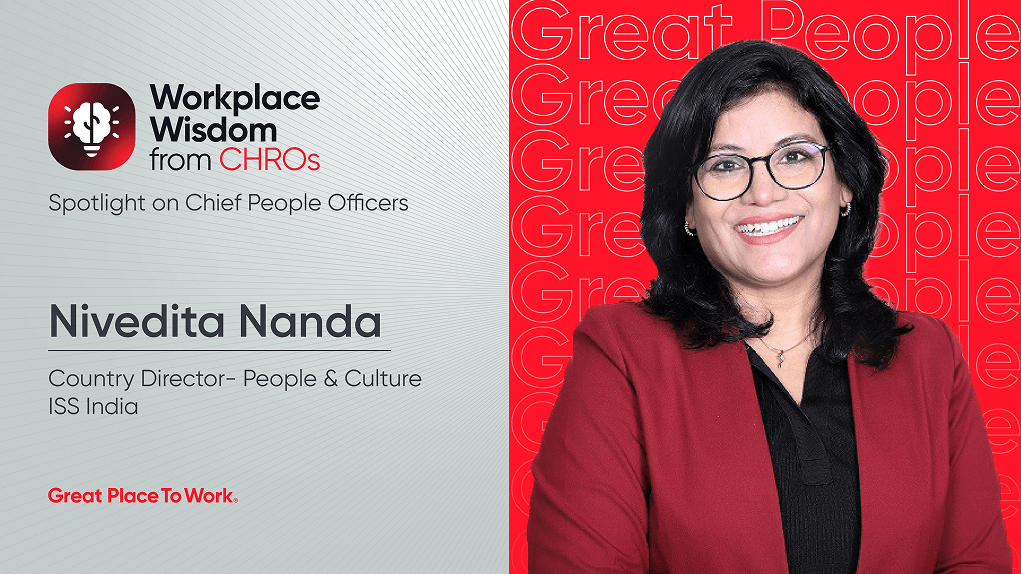

Nivedita Nanda brings a rare blend of military discipline and cross-industry HR leadership to ISS India. A former Indian Air Force Pilot Officer, she has led people strategies across infrastructure, healthcare, media, retail, and energy at Kaya Ltd., Future Group, Prime Focus, Reliance Health, Reliance Energy, and Praxair. At ISS India, she helps strengthen a 45,000+ strong workforce driving safe, sustainable, and socially impactful workplace solutions.
ISS Facility Services India Private Limited is Great Place To Work CertifiedTM for 5 years in row, and is ranked #11 in Top 100 India’s Best Companies To Work For 2025 among many other prestigious recognitions.
In Nivedita’s words:
Q1 . You began your career in the Indian Air Force- a world defined by discipline, purpose, and precision. How has that experience shaped your leadership philosophy in the corporate world?
When I look back, my leadership journey truly began on the runways of the Indian Air Force, not in a boardroom. I still remember the early mornings when discipline wasn’t just expected, it was a way of life. Every task demanded precision, teamwork, and trust. There was no room for ‘almost’ right.
We had to make quick decisions with limited information, and every second mattered. In that moment, I learned that leadership isn’t about giving orders; it’s about staying calm when everyone else is looking for direction, trusting your team, and ensuring they trust you back.
When I transitioned into the corporate world, that mindset became my compass. I realized that while the environment had changed, the essence of leadership was the same. It’s still about clarity of purpose, disciplined execution, and caring for your people.
Today, I lead with the same principles the Air Force instilled in me: be precise in vision, decisive in action, and unwavering in integrity. Whether it’s managing a project deadline or navigating business uncertainty, I approach every challenge like a mission with preparation, calm under pressure, and a deep respect for the team that makes success possible.
Q2. What are the top three key people/ engagement metrics you consistently monitor, and how do they help you make informed decisions about your people strategy?
When it comes to people and engagement, I believe that what gets measured gets improved, but only if we look beyond the numbers to understand the story they tell. Over the years, I’ve focused on three key metrics that consistently guide my people strategy:
I focus on three key people and engagement metrics:
1. Engagement and sentiment scores – They reveal how employees feel about leadership, culture, and purpose, helping identify early signs of disengagement or burnout.
2. Retention and internal mobility – These show whether we’re building careers or losing talent. Healthy internal movement signals a strong culture of development.
3. Performance & engagement correlation – This connects people’s experience to business results, ensuring our HR initiatives drive productivity and growth.
Together, these metrics help me make our people strategy, both data-driven and human-centered, aligning employee well-being with organizational performance.
Q3. In an industry where many employees are frontline or client-facing, what practices have proven most effective in driving engagement and belonging?
In frontline and client-facing roles, engagement starts with connection and recognition. What’s worked best for me are three simple but powerful practices:
1. Listening from the ground up – At ISS, we believe listening is where trust begins. That’s why we conduct regular pulse checks through our My Voice survey, the Great Place To Work® survey, skip-level conversations, and open forums. These aren’t just processes; they’re moments where our people truly feel heard. And when employees see that their feedback actually leads to change, that’s when trust really takes root, not because we ask for it, but because we’ve earned it.
2. Recognition in real time – Acknowledging everyday wins, not just quarterly results, creates pride and motivation. Peer-to-peer recognition platforms have been especially effective in fostering community.
3. Development and dignity – Frontline employees feel most valued when they see growth opportunities. Investing in upskilling, safety, and well-being signals genuine respect for their contribution.
Ultimately, belonging comes from feeling heard, appreciated, and invested in, regardless of where you sit within the organisation.
Q4. Can you share an example of how feedback from a previous Trust Index survey led to a meaningful shift in culture or policy at ISS India?
One powerful impact emerged from a Trust Index survey, in which employees highlighted gaps in career visibility and in communication from leadership. While engagement scores were strong overall, the feedback made it clear that our people wanted more clarity about growth and recognition.
In response, we launched the “Career Pathways” initiative, mapping out transparent development tracks for frontline and managerial roles. We also started a programme named as ‘The ISS Stardom’ Programme, which is all about celebrating and supporting our Placemakers, the people who bring our purpose to life every day. Through this initiative, we not only recognize their contributions but also extend our support to their families and communities. It’s designed to help our people grow and stay inspired by rewarding great work, nurturing talent, and creating meaningful opportunities for career development.
Within a year, we saw a noticeable rise in both engagement and trust scores. People began to feel that their voices mattered and shaped the way we lead.
Q5. ISS India has been recognised in Top 100 India’s Best Companies To Work For for 5+ years. How do you leverage this recognition, and what impact has it had on talent attraction, employee pride, and leadership credibility?
A few years ago, when ISS India first made it to India’s Top 100 Best Companies To Work For, it felt like a proud milestone. However, staying on that list for over five years has made it an integral part of our story.
We’ve seen how that recognition draws talent to us. Candidates often say, “I applied because I’ve heard ISS is a great place to work.” It has become a magnet for individuals who want to be part of a company that genuinely values its employees.
Inside the organization, it’s a badge of pride. Teams celebrate it as their win, proof that the culture we talk about is something we actually live. And for our leaders, it’s validation that our people-first approach isn’t just words; it’s working.
This recognition has done more than enhance our brand – it’s strengthened our belief, both inside and outside ISS, that when you invest in people, everything else follows.
Q6. ISS has been in business for over 125 years globally and over 2 decades in India. How do you translate its longstanding cultural values into practices that resonate with today’s evolving employee expectations in India?
At ISS, our story is one of purpose and people. For over 125 years globally and more than two decades in India, our culture of care, respect, and service excellence has remained the foundation of who we are. But what makes it truly meaningful is how we bring those values to life in today’s world.
In India, we’ve evolved our practices to meet the aspirations of a new generation of employees. You might be surprised to know that we currently have three generations from the same family working with us, something we take great pride in. We focus on inclusion, continuous learning, and well-being, ensuring every individual feels valued and empowered. We have over 45,000 people across the country; meaning, we’re providing livelihoods to 45,000 families as one organisation. That’s a responsibility we carry with pride and purpose.
Our belief in social sustainability strengthens this commitment. Through the ISS India Foundation, we extend our culture of care beyond the workplace, supporting education, skill-building, and community welfare initiatives that uplift society.
So, while times and expectations evolve, our mission remains the same: to care for people, for places, and for the planet, ensuring that our growth touches lives far beyond the walls of our business.
Q7. What part of your work do you look forward to the most?
What I look forward to most is connecting with our people, hearing their stories, their ideas, and seeing how they bring their whole selves to work. At ISS, our business core is people- everything we do, we keep them at the centre, because when our people grow, our business grows too.
Every conversation reminds me why ISS truly is “A Place to Be You.” I love those moments when feedback turns into action, when recognition inspires someone, or when a development opportunity helps them take the next step. That’s the most rewarding part, seeing how empowering our people not only builds pride and trust but also drives our collective growth.
Q8. If you had to describe your journey with Great Place To Work in just one word, what would it be, and why?
“Transformative.”
Because the journey with Great Place To Work has reshaped how we see our people, our culture, and our leadership. It has helped us evolve from good intentions to measurable impact.
If you’re a People Leader managing a High-Trust High-Performance work environment, and are interested to be interviewed with Great Place To Work India, feel free to write in to in_researchandinsights@greatplacetowork.com