
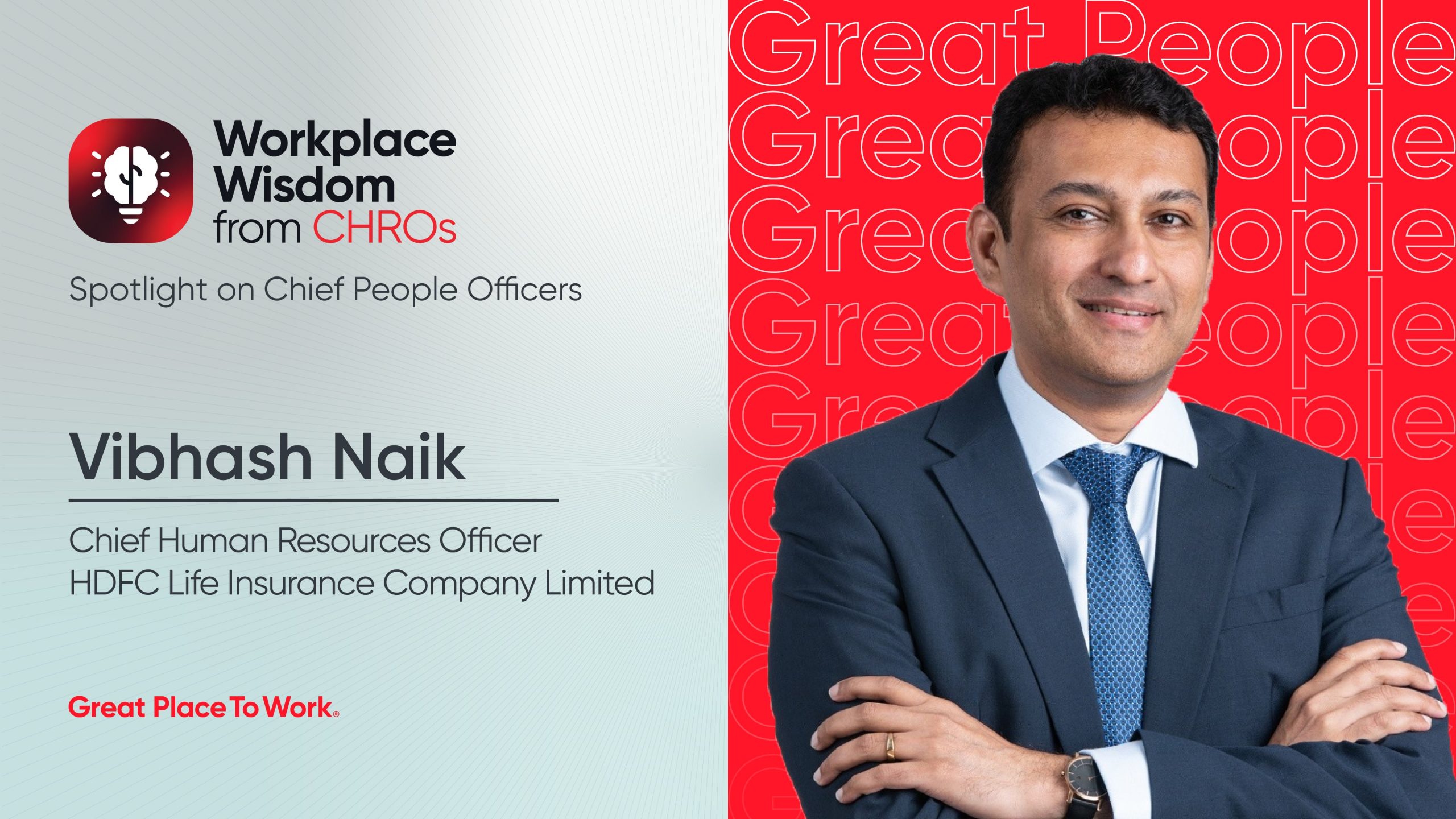
Vibhash Naik, Chief Human Resources Officer at HDFC Life Insurance, is a transformational HR leader with over 25 years of experience driving business growth through people excellence. With a proven track record across the BFSI and IT sectors, he has led large, multidisciplinary teams to build cultures of innovation, inclusivity, and operational excellence.
HDFC Life Insurance is ranked #7 in Top 100 India’s Best Companies To Work For 2025, and ranked #49 Best Workplaces™ in Asia 2025- Large, among many other prestigious recognitions.
Vibhash unpacks his perspectives:
Q1. Looking back on your 25+ years in HR, what pivotal moments have shaped your leadership style and philosophy?
Over the past twenty-five years, I’ve had the opportunity to work with several organizations and have led almost every facet of HR – individually, as a collective head, and now as a CHRO.
Interestingly, along this journey, I’ve witnessed some of the most defining moments of our times firsthand: the global financial meltdown, the first IPO of a life insurance company, a pioneering industry merger of HDFC Life and Exide Life, and then the black swan event that touched all of us – the pandemic of COVID-19. I’ve seen it all in action.
As I now look back, these moments have had a deep impact on my philosophy as a leader – that the world is inherently dynamic, and one must remain agile and open to change. It is your ability to foresee this uncertainty and prepare for it that will help you stay ahead of the curve. Complacency has no place – because if you become complacent, extinction is inevitable. This truth holds equally true for businesses, systems, and even leaders.
Q2. How do you personally define a “great place to work,” and how does that definition shape your people strategy at HDFC Life?
I would call a company a great place to work if it stands true on three parameters:
- A company that brings out the best in people by offering opportunities, challenges, and loads of trust.
- A place where one feels genuinely valued and included.
- A brand that is recognized for upholding its values and ethics; and I say this because a company cannot be a great workplace unless it is first a good place for its customers.
This approach has influenced HDFC Life’s people philosophy. Over the years, we have built a culture rooted in trust, camaraderie, and inclusion. Open communication, transparency, fairness in employee processes, and ensuring that everyone feels an equal part of the organization have shaped who we are today.
Q3. What are the top three key people/ engagement metrics you consistently monitor, and how do they help you make informed decisions about your people strategy?
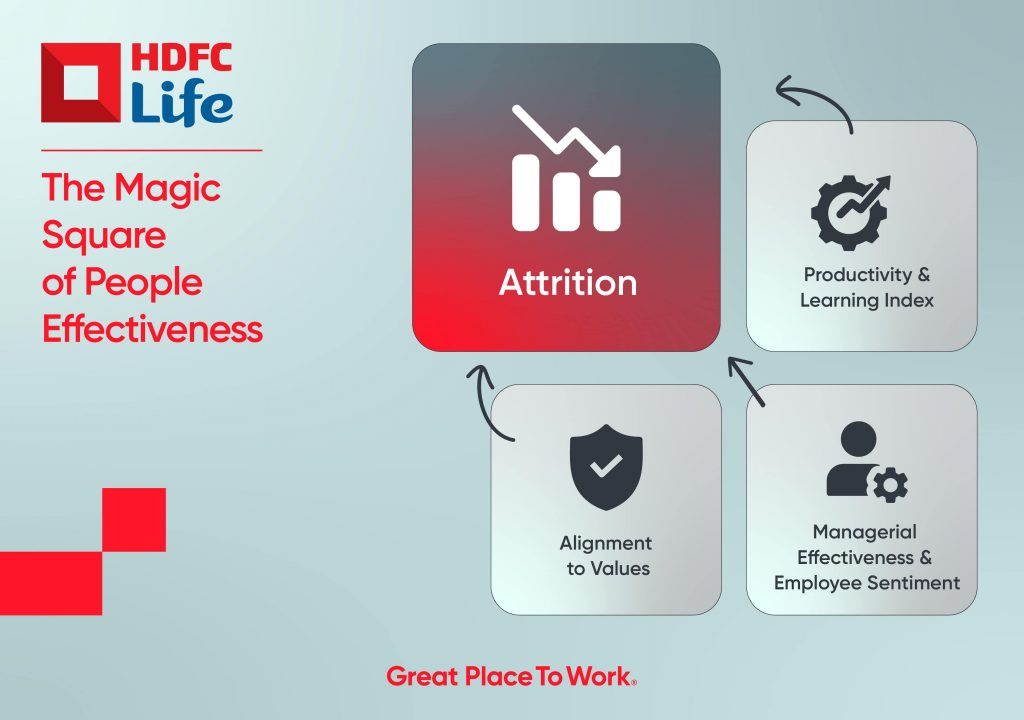
While there’s a large dashboard of parameters that we monitor, the following four are the most crucial from an employee engagement perspective.
Being in a high-churn industry, we closely track attrition on a regular basis across demographics such as tenure, managers, geographies, and channels. This helps us identify which “bucket” is leaking and what may be causing it, so we can plan the right interventions.
Second, we look at productivity and the learning index side by side, assessing whether our people are productive and whether learning truly helps them. We want our employees to be successful, to realize their full potential, and see HDFC Life as the place where they can soar in their careers.
Third, we monitor managerial effectiveness and employee sentiment, especially around transparency, inclusion, and belongingness. This parameter guides us in taking new initiatives for employee engagement.
Fourth, and the most crucial one is that we track alignment to our values. This includes monitoring customer complaints, team engagement, and other indicators to ensure HDFC Lifers are truly living the values that we stand for.
Together, these four parameters form what we call the “magic square of people effectiveness” where the latter three parameters directly influence the first, which is attrition.
Q4. What’s one initiative or practice you’ve led that had a measurable impact on workplace culture and business performance?
One initiative where I feel we’ve made a significant impact is in how we’ve “democratized” learning by offering multiple mediums and diverse formats of content and communication. Around 8–9 years ago, our learning ecosystem consisted of a sales training team (with trainers and a content team) and an online LMS. The upgraded learning framework addresses three major challenges-
01 Scaling the learning model to reach all employees
02 Customize learning based on each employee’s need and style
03 Making learning “pull-based” rather than something pushed by the L&D team
With these goals in mind, we set out to build a multi-faceted, inclusive learning environment rooted in the philosophy of democratizing learning. So, what did we do?
We took a three-pronged approach:
Firstly, we identified a diverse set of learning mediums to deliver content like WhatsApp, classroom sessions, Smart Talks, which is our version of TED Talks, and a personalized mobile learning app named MLearn. We leveraged all of them.
Second, we created a wide variety of content: Instructor-Led Trainings (ILTs), online games, quizzes, leaderboards, comic strips, cartoons, memes and more. We enabled this content using the latest technologies and MLearn which recommends courses based on your departments and learning preferences. Another example is our AI coach, the first of its kind in the industry. This app allows users to record a product pitch video and receive instant feedback on their pitching style and product knowledge. Our entire Operations team is a part of Operations Champions League where there’s a quiz every Friday and the annual winners are felicitated and rewarded. It’s fun seeing the energy on the floor every Friday morning.
Third, to make learning “pull-based,” we introduced learning frameworks that enable employees to learn independently, earn points, and get rewarded. Rewards include monetary benefits, promotions, and more. For each department, a curated set of external courses is available on our internal platform called ILearn. Employees select a course, complete it, and earn the required points.
All of this is in addition to traditional classroom sessions and leadership development programs.
We’ve also revamped our induction programs, which now include 80% simulated work labs. For example, a bank sales employee undergoes training in a simulated bank branch making it practical and realistic for them.
I’d say the impact has been strong so far with more employees getting trained, and those who are trained show higher retention and engagement. Clear productivity improvements are visible. So, there’s real value for the effort. And because the learning mediums are diverse, multiple generations enjoy and engage with the content.
Q5. As Gen Z enters the workforce, how is HDFC Life adapting its culture and policies to align with their expectations, values, and workstyles?
Every generation that enters the workforce brings something different. If we look back to the time around India’s independence, each wave of professionals has had its own identity. Even when we joined as Gen X, the Baby Boomers saw us as different. Similarly, Gen Z is unique, shaped by a very different ecosystem. They are tech natives, have broader exposure, thanks to social media, and hold strong opinions. And HDFC Life is all geared up to leverage their uniqueness and strengths.
Over the last few years, we’ve introduced several initiatives from AI-based learning platforms, gamification, reverse mentoring opportunities to flexible work contracts- we have everything that resonates with new generations.
Recently, we revamped a performance management system at entry level for one of the channels. We’ve created a gamified digital wallet where everything you do – from learning to selling to displaying values helps you earn points. And these points help you grow fast. Earn more and grow fast. It’s all gamified.
One more recent change we’ve made is revamping our offices to create vibrant, collaborative spaces with phone booths, bean bags, and couches. I would say Gen Z will love that space but would anyone dislike that new space? No. It’s something that benefits everyone. So largely, if you call yourself a modern workplace then you are already building something for the new generations like Gen Z and Gen Alphas soon.
Gen Zs are a part of us and we’re ready to be working with them, learning from them, and embracing the fresh perspectives they bring. We also know Gen Z will form a significant part of our customer base, which is why we’ve started featuring them as brand ambassadors in our ads and social media reels.
Q6. ‘Insurance for all’ by 2047 is an ambitious vision set by the IRDAI, and HDFC Life is a major contributor towards the vision. What role do HR and culture play in achieving this long-term vision?
This vision of the Government of India is ambitious and will require us to reach every corner of the country, from metros to rural India. HDFC Life has progressed well in our expansion strategy to align with this vision.
The People Function will be a key function in supporting this growth by supplying manpower, training the staff, arranging offices and facilities, and by fostering a customer-focused culture among employees.
In the last two years, we’ve opened 150+ branches already; we’ve added 4K to our headcount that includes sales and support staff. So, while the growth plans can be made on paper, our people will execute it and HR will have to take centre-stage to bring this vision to life.
I feel, we’ll also have to heavy-lift in bringing more tech talent on board to support all-round expansion. Speed will be of the essence, so a little bit of agile work models will have to be explored. HDFC Life has already experimented with and restructured its tech function into Pod structures to improve agility in operations.
For us, this expansion is also a massive opportunity to create new avenues of growth for internal talent and build a stronger leadership bench.
From culture standpoint, we’ll have to ingrain Customer Centricity deeper into our employee DNA. We’ll have to ensure that every life we insure is seen as a responsibility and not a target achievement. Only then we will meet the vision in true spirit.
Q7. HDFC Life has been recognised as Rank #7 in India’s Best Companies To Work For 2025. How do you leverage this recognition, and what impact has it had on talent attraction, employee pride, and leadership credibility?
It’s encouraging to see our rank rise to seven on the Great Place To Work Top 100 India’s Best Companies To Work For 2025 list. It is a badge we all wear proudly, both as employees and as the HR team. It is indeed a matter of pride, and it certainly helps us get noticed and trusted by both potential talent and our existing employees.
For HDFC Life, this badge also fuels our ambition; we see this ranking as a reflection of our employees’ trust, and we’re committed to not only retaining it but also raising the bar every year.
Q8. Can you share an example where feedback from a previous Trust Index survey led to a meaningful shift in culture or policy?
Over the years, our collaboration score has been an area of improvement for us. So, a year ago, we decided to take this theme head-on and launched several initiatives to foster a culture where employees truly felt like one team.
Some of the things we did include announcing an annual theme of “Win As One,” which featured across all our communications, emails, presentations, and town halls. All our workshops carried the essence of how we could “Win As One” or, how we could collaborate better.
We also launched ColLab workshops, which went a step deeper by bringing together teams that worked with each other but often felt a rift between them. And, beyond work, we created many informal opportunities to strengthen team bonds, such as cricket matches and other engagement events.
This insight from Great Place To Work became a mission, and it’s good to see that collaboration is now on everyone’s mind. The sentiment is improving and this is just the beginning.
Q9. What part of your work do you look forward to the most?
It’s hard to pinpoint just one area, but I’ll share the ones that give me an adrenaline rush every day. It’s the challenge of influencing a large, multi-locational, multi-generational, and diverse workforce to demonstrate behaviours that align with our Values. It feels like shaping the organization’s DNA. And then sustaining and nurturing a strong culture that outlives any one leader and continues to drive the organizational success for years to come.
Q10. Looking ahead, what is one mindset you believe the next generation of HR leaders must develop to be future-ready?
I firmly believe that HR leaders should have a seat at the organization’s decision-making table. HR cannot be seen merely as a function that recruits people, onboards them, or organizes engagement events. HR leaders need to contribute strategically to business decisions, drive organizational development, and be able to measure the impact of every dollar spent on their initiatives.
In the future, the HR leaders who will succeed are those who can balance the right brain, that is, empathy and people understanding, with the left brain that rules logic, numbers, and business impact.
Q11. If you had to describe your journey with Great Place To Work in just one word, what would it be, and why?
I’d say, the journey has been “inspiring” because the pride of being called a great workplace has truly inspired us to keep our employees at the centre of our decisions, review our processes from time to time and keep asking ourselves this question “Are we truly a Great Place to Be? And what we could do better?” So, yes, our journey has been “inspiring!”
If you’re a People Leader managing a High-Trust High-Performance work environment, and are interested to be interviewed with Great Place To Work India, feel free to write in to in_researchandinsights@greatplacetowork.com